Raksha Bandhan history is much more than the story of a colourful thread tied on a brother’s wrist. It is a journey through ancient Indian civilisation, mythology, royal traditions, and family values that have survived for thousands of years. Every year, as the full moon of Shravan arrives, homes across India come alive with laughter, sweets, prayers, and heartfelt reunions. Yet behind these familiar celebrations lies a fascinating history that many people know only in fragments.
Growing up in Delhi, I have always loved watching Raksha Bandhan history transform ordinary neighbourhoods into festive streets. Markets overflow with beautifully crafted rakhis, sweet shops remain crowded from morning until late evening, and courier offices become busy as families send gifts across India and abroad. Despite this excitement, I often noticed that conversations revolved around shopping lists or auspicious timings rather than the remarkable story behind the festival itself.
That curiosity inspired me to explore the deeper roots of Raksha Bandhan history and understand how a simple sacred thread became one of India’s most cherished cultural symbols.
Unlike many festivals that can be traced to a single historical event, Raksha Bandhan evolved gradually through mythology, religious traditions, folklore, and regional customs. Ancient Hindu scriptures speak about protective threads tied during sacred rituals, while later legends introduced inspiring stories of devotion, courage, and unwavering trust. Over the centuries, these traditions blended together, transforming Raksha Bandhan into a celebration that represents protection, gratitude, and lifelong relationships rather than merely a yearly ritual.
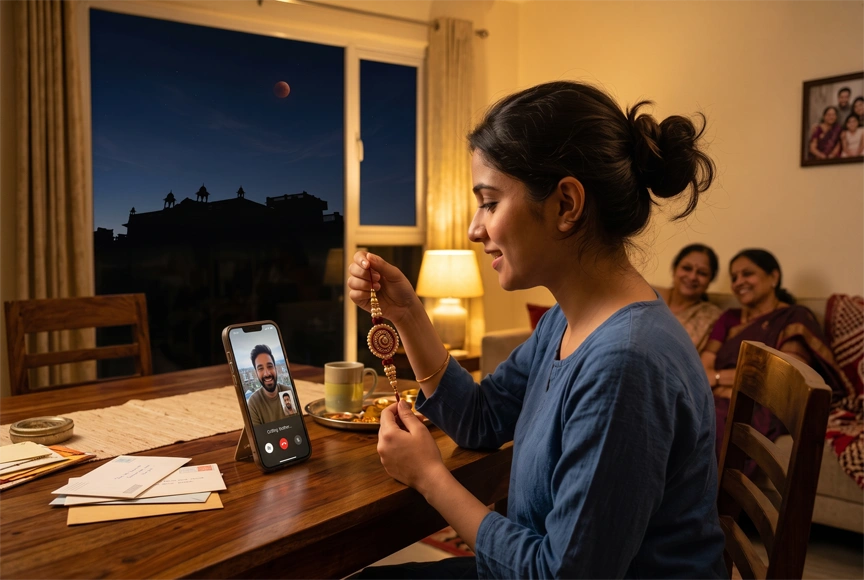
Today, the Raksha Bandhan history extends far beyond biological siblings. Sisters tie rakhi to cousins, close friends, mentors, soldiers, and even deities as a symbol of affection and goodwill. Families separated by continents celebrate through video calls, courier deliveries, and virtual ceremonies, proving that the emotional essence of the festival remains unchanged despite changing lifestyles. This ability to adapt while preserving its core values is one of the reasons Raksha Bandhan continues to hold a special place in Indian culture.
In this guide, we will explore the complete Raksha Bandhan history—from its earliest Vedic roots and fascinating mythological legends to medieval traditions, modern celebrations, and the unique significance of Raksha Bandhan 2026. Along the way, we will separate historical facts from popular folklore, explain the symbolism behind the sacred thread, and discover why this beautiful festival continues to inspire millions of families around the world.
The name Raksha Bandhan comes from two Sanskrit words: Raksha, meaning protection, and Bandhan, meaning bond or tie. Together, they describe a sacred relationship built on mutual care, trust, and responsibility. Although many people associate the festival primarily with brothers promising to protect their sisters, its original meaning was much broader. In ancient India, a sacred thread represented blessings, spiritual protection, and a solemn promise to uphold righteousness.
Ancient Origins of Raksha Bandhan
To understand Raksha Bandhan history, we must travel back to the Vedic period, long before colourful designer rakhis, online gift deliveries, and family selfies became part of the celebration. Historians believe the earliest form of the festival was not exclusively associated with brothers and sisters. Instead, it centred on the concept of the Raksha Sutra, a sacred protective thread tied during religious ceremonies to invoke divine blessings and ward off misfortune.
In Vedic traditions, rituals were deeply symbolic, and every object used during a ceremony carried spiritual significance. Among these, the sacred thread represented protection, purity, and the devotee’s connection with divine power. During important yajnas (fire sacrifices), priests tied a consecrated thread around the wrists of kings, warriors, students, and householders while chanting Vedic mantras. This thread was believed to safeguard the wearer from negative influences and remind them of their moral responsibilities.
The concept of protection in ancient India extended far beyond physical safety. It also referred to protecting one’s values, family, community, and commitment to dharma—the principle of righteous living. This broader understanding explains why Raksha Bandhan history cannot be reduced to a simple exchange between siblings. At its heart, the festival celebrates trust, responsibility, and mutual care, values that remain relevant even in modern society.
The Raksha Sutra Tradition
Ancient Hindu scriptures mention the Raksha Sutra as a sacred thread blessed through prayers and rituals before being tied around the wrist. Unlike modern decorative rakhis, these threads were simple, often made of cotton dyed in auspicious colours such as red, yellow, or saffron. The thread itself held little material value, but its spiritual meaning was immense.
Even today, many Hindu priests continue this centuries-old tradition by tying a protective thread to devotees during religious ceremonies, temple festivals, and important life events. In several regions of India, this practice exists alongside the modern sibling celebration, reminding us that Raksha Bandhan evolved from an older religious custom rather than appearing suddenly in its present form.
The Story of Indra and Indrani
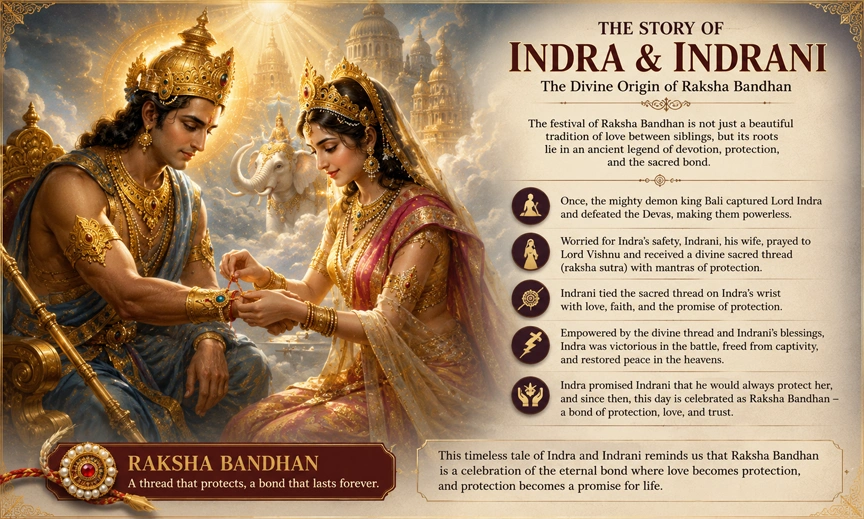
One of the earliest legends associated with Raksha Bandhan history appears in the Bhavishya Purana. According to the story, the gods were engaged in a fierce battle against the powerful demon king Vritra. As the conflict intensified, Indra, the king of the gods, found himself losing confidence. Concerned for her husband’s safety and the future of the heavenly kingdom, his wife Indrani turned to sacred rituals for guidance.
Following the advice of divine sages, Indrani prepared a holy thread by chanting protective mantras and tying it around Indra’s wrist before he returned to the battlefield. This was not a gesture between siblings but an act of faith, courage, and spiritual protection. Strengthened by her blessings and renewed determination, Indra ultimately defeated Vritra and restored peace to heaven.
Whether viewed as mythology or symbolic storytelling, this legend reveals an important truth about Raksha Bandhan history. The sacred thread originally represented divine protection and moral strength rather than a family custom alone. Over time, as Indian society evolved, these broader meanings merged with stories of sibling affection, creating the beautiful festival celebrated today.
The journey from sacred Vedic ritual to family celebration did not happen overnight. It unfolded gradually through mythology, regional traditions, and changing social values, making Raksha Bandhan one of India’s richest and most enduring cultural festivals.
The Yama and Yamuna Legend: The Heart of Raksha Bandhan History
Among all the stories associated with Raksha Bandhan history, the legend of Yama and Yamuna remains one of the oldest and most touching. Unlike tales of kings and battles, this story focuses entirely on the emotional bond between a brother and his sister. It explains why the festival is celebrated not merely as a ritual but as a heartfelt expression of love, remembrance, and lifelong protection.
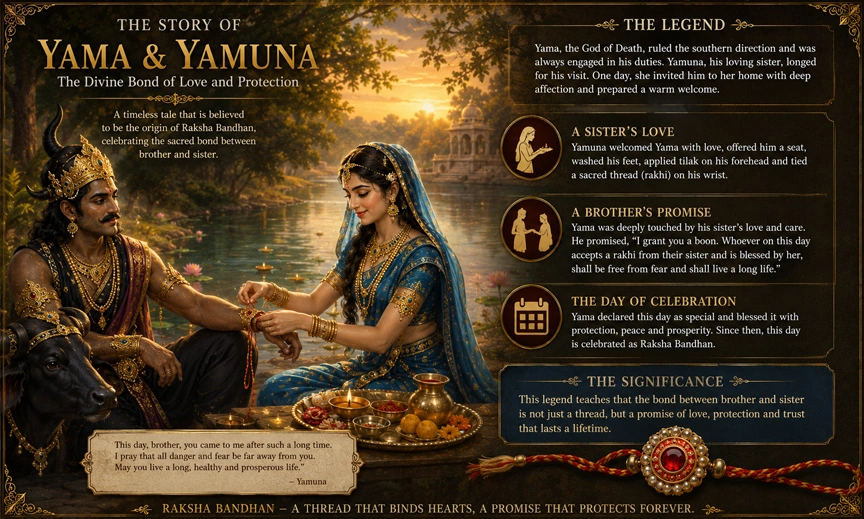
According to Hindu tradition, Yamuna, the goddess of the sacred river, deeply missed her brother Yama, the god of death. Burdened with his divine responsibilities, Yama had not visited his sister for many years. Yamuna continued to pray for his well-being and hoped that one day he would come to her home.
When Yama finally arrived, Yamuna welcomed him with warmth and devotion. She prepared a traditional meal, performed an aarti, applied a ceremonial tilak on his forehead, and tied a sacred thread around his wrist while praying for his long life and happiness. Moved by her unconditional affection, Yama granted her a special blessing. He declared that any brother who received such a sacred thread from his sister with sincerity and love would enjoy divine protection and prosperity.
Although the story belongs to mythology, its message continues to resonate across generations. The thread does not possess magical powers on its own. Instead, it represents a promise of mutual care, emotional support, and unwavering trust. This timeless idea is one of the reasons Raksha Bandhan history has remained relevant for centuries.
More Than a Promise of Protection
Modern interpretations often describe Raksha Bandhan history as a festival where a brother promises to protect his sister. However, the Yama and Yamuna legend suggests a more balanced relationship. Yamuna’s prayers gave strength to Yama, while Yama’s blessing recognised her love and devotion. The festival therefore celebrates mutual responsibility rather than one-sided protection.
This broader understanding reflects the values of contemporary Indian families as well. Today, sisters support their brothers emotionally, professionally, and financially, just as brothers stand beside their sisters during important moments in life. Raksha Bandhan history has evolved into a celebration of equality, affection, and shared responsibility.
The Story of Krishna and Draupadi
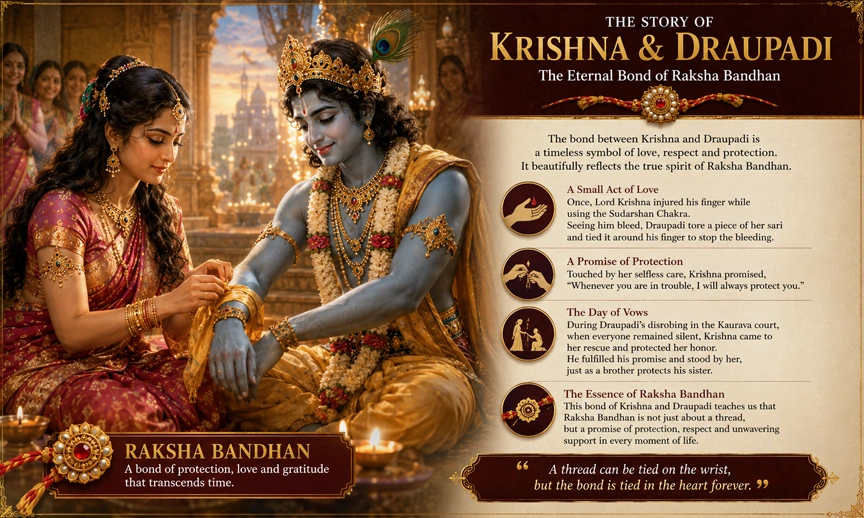
Another beloved episode connected with Raksha Bandhan history comes from the Mahabharata and involves Lord Krishna and Queen Draupadi. Although the epic never explicitly describes the occasion as Raksha Bandhan, the story beautifully reflects the spirit of the festival.
According to popular tradition, Krishna once injured his finger while handling the Sudarshan Chakra. Seeing him bleed, Draupadi immediately tore a small strip from the edge of her sari and gently wrapped it around his finger to stop the bleeding. Her spontaneous act of compassion required no ceremony or expectation of reward. It was simply an expression of genuine care.
Krishna accepted this gesture with gratitude and is believed to have promised that he would always protect Draupadi whenever she needed him. Years later, during the infamous episode of the dice game in the Kaurava court, Krishna came to her aid when she was publicly humiliated. As Dushasana attempted to disrobe her, Krishna miraculously extended her sari endlessly, preserving her dignity before the royal assembly.
Whether interpreted as history, symbolism, or devotional tradition, this episode has become an integral part of Raksha Bandhan history because it demonstrates that true protection is rooted in compassion, gratitude, and selfless relationships rather than blood ties alone.
These timeless legends gradually transformed the meaning of Raksha Bandhan from an ancient religious ritual into a celebration of enduring human relationships. As Indian society evolved, these stories blended with regional customs and historical events, giving the festival the rich cultural identity it enjoys today.
Rani Karnavati and Humayun: History, Legend, and the Spirit of Raksha Bandhan History
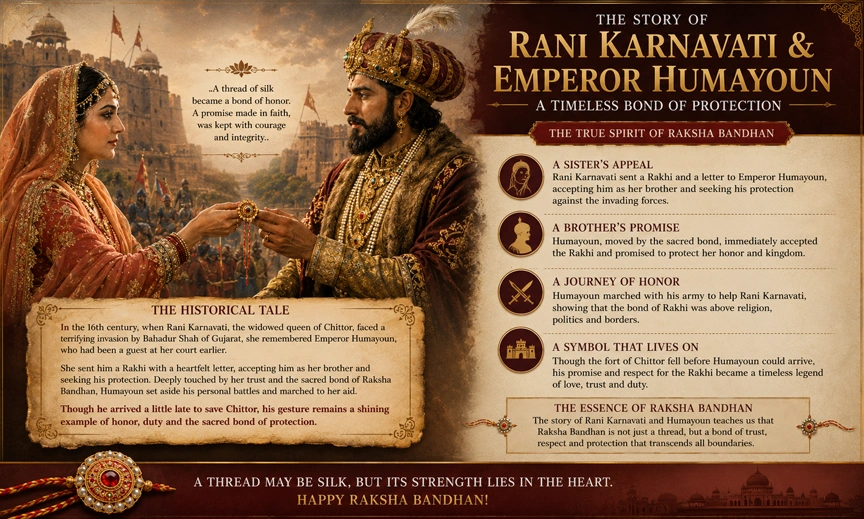
No discussion of Raksha Bandhan history feels complete without mentioning the famous story of Rani Karnavati of Mewar and the Mughal emperor Humayun. It is one of the most popular narratives associated with the festival, yet it is also among the most debated by historians. While the historical evidence is limited, the story has survived for centuries because of the powerful values it represents rather than the certainty of every historical detail.
According to popular tradition, Rani Karnavati, the widowed queen of Chittor, faced a grave military threat from Bahadur Shah of Gujarat during the sixteenth century. Realising that her kingdom was vulnerable and her forces were greatly outnumbered, she looked beyond political alliances for support. As a gesture of trust and goodwill, she is believed to have sent a rakhi to Emperor Humayun, asking him to protect her kingdom as a brother would protect his sister.
The story says that Humayun accepted the symbolic relationship with great respect. Although he reportedly began marching towards Chittor with his army, he arrived too late to prevent the tragic siege. Rani Karnavati and many royal women are said to have performed jauhar, while the Rajput warriors fought until their last breath.
Modern historians continue to debate whether this exchange of a rakhi actually took place. Contemporary records do not provide conclusive proof, and several scholars believe the story became popular through later historical writings and folklore. Even so, its cultural importance remains undeniable. For generations of Indians, the tale has symbolised honour, compassion, and the belief that a sacred bond can rise above differences of religion, politics, and power.
History and Cultural Memory
Whether every detail is historically accurate or not, the legend illustrates an important aspect of Indian storytelling. Cultural memory often preserves values as much as historical facts. In this case, the rakhi becomes more than a ceremonial thread—it represents trust offered during a moment of crisis and the hope that moral responsibility can overcome political divisions.
This is one reason the story continues to appear in books, documentaries, and conversations about Indian heritage. Rather than reading it only as a military episode, many people view it as a reminder that relationships built on respect can influence history in unexpected ways.
How Raksha Bandhan History Evolved Through Medieval India
As Indian society changed over the centuries, the meaning of Raksha Bandhan continued to evolve. What had begun as a sacred ritual associated with Vedic ceremonies and mythological traditions gradually became woven into everyday social life. The festival no longer belonged only to temples or royal courts; it became part of family customs, village celebrations, and community relationships across the country.
In several regions, women tied protective threads to kings before important journeys or military campaigns, praying for their success and safe return. Priests continued to tie the Raksha Sutra during religious ceremonies, while families adapted the tradition into a celebration of sibling affection. This gradual transformation demonstrates how Indian festivals often grow by absorbing local customs without losing their original spiritual meaning.
By the medieval period, Raksha Bandhan had also become a symbol of social harmony. Communities used the festival to strengthen friendships, settle differences, and reaffirm relationships built on mutual respect. In some places, people even exchanged rakhis across caste and community boundaries, reflecting the belief that trust and goodwill were stronger than social divisions.
The Sacred Thread as a Symbol of Responsibility
One of the most remarkable aspects of Raksha Bandhan history is that the rakhi has never been viewed merely as a decorative ornament. It represents a promise that carries emotional, moral, and sometimes spiritual significance. The thread reminds both the person tying it and the one receiving it that every meaningful relationship requires care, respect, and responsibility.
Today, this symbolism continues in countless Indian homes. Some families begin the ceremony by offering the rakhi before a household deity, while others include prayers, sweets, and gifts that reinforce the values of gratitude and togetherness. Although the celebrations have adapted to modern lifestyles, the underlying message has remained remarkably consistent across generations.
From ancient rituals and mythological legends to royal traditions and community celebrations, Raksha Bandhan history has continually evolved without losing its central purpose. The sacred thread has become a timeless reminder that genuine relationships are strengthened not by grand promises alone, but by everyday acts of kindness, loyalty, and unwavering support.
How Raksha Bandhan Is Celebrated Across India
One of the most fascinating aspects of Raksha Bandhan history is that the festival has never been celebrated in exactly the same way across India. While the central idea of strengthening relationships through a sacred thread remains unchanged, every region has added its own customs, prayers, foods, and traditions over centuries. This regional diversity has helped Raksha Bandhan remain relevant for generations, allowing communities to preserve their local identity while participating in a festival that unites millions of people.
Today, Raksha Bandhan is observed not only in metropolitan cities such as Delhi, Mumbai, Bengaluru, and Kolkata but also in small towns and villages where family traditions continue to shape the celebrations. Although modern lifestyles have introduced online shopping, digital payments, and video-call ceremonies, the emotional warmth of the festival has remained remarkably constant.
North India: Where the Festival Comes Alive
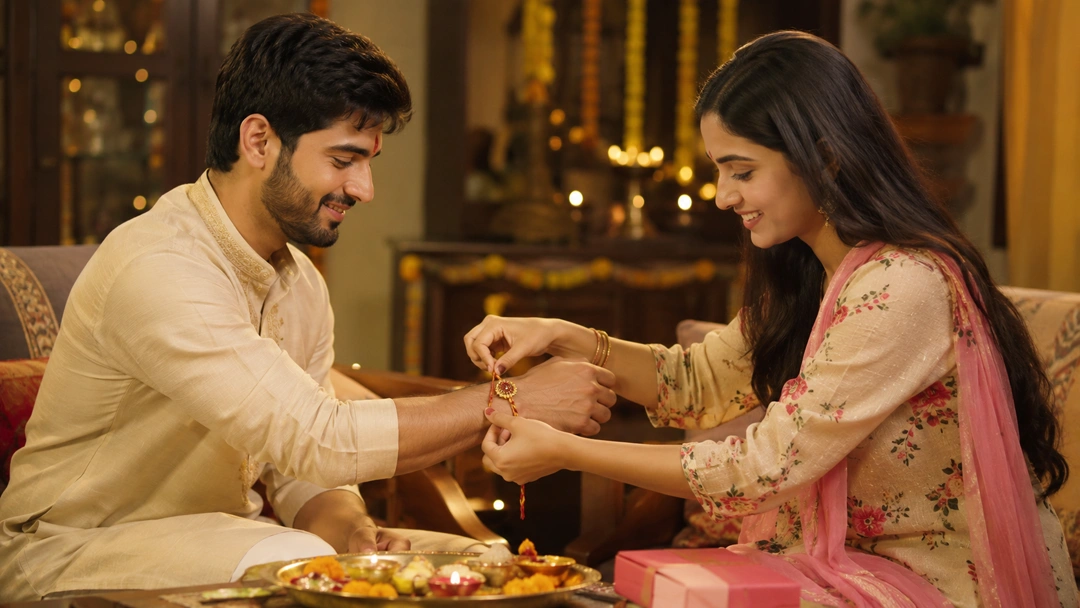
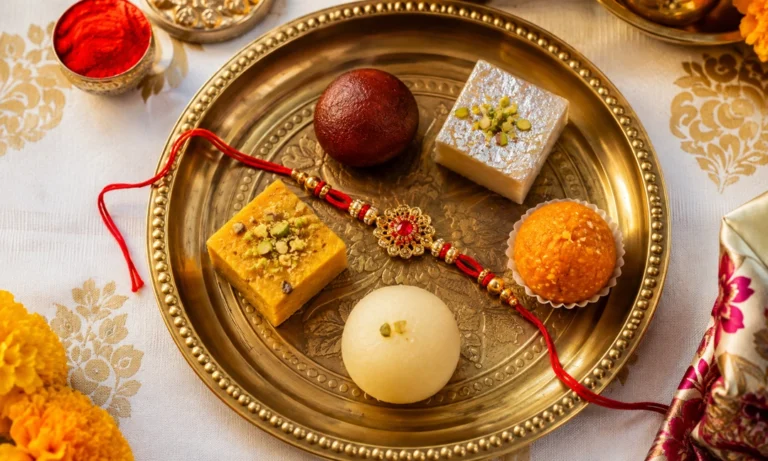
In North India, Raksha Bandhan is celebrated with great enthusiasm. The day usually begins with family members wearing traditional clothes before gathering for the ceremony. Sisters prepare a beautifully decorated puja thali containing a rakhi, diya, kumkum, rice grains, sweets, flowers, and incense sticks. After performing an aarti, they apply a tilak to their brother’s forehead, tie the rakhi around his wrist, offer sweets, and pray for his health, prosperity, and long life.
Brothers traditionally respond by presenting gifts or money and expressing their commitment to supporting their sisters throughout life. In many modern families, however, the exchange is no longer viewed as a one-sided promise. Instead, both siblings acknowledge that love, respect, and emotional support flow equally in both directions.
Growing up in Delhi, I have always noticed how Raksha Bandhan transforms the city. Markets such as Chandni Chowk, Lajpat Nagar, Karol Bagh, and Sadar Bazaar become crowded with families searching for handcrafted rakhis, decorative gift boxes, traditional sweets, and festive clothing. Even metro stations feel different on the festival morning, with passengers carrying beautifully wrapped gifts and colourful thalis as they travel to meet loved ones.
Western India: Tradition Meets Community Spirit
In Maharashtra and neighbouring regions, Raksha Bandhan often coincides with Narali Purnima, a festival dedicated to the sea god Varuna. Coastal fishing communities offer coconuts to the sea before beginning a new fishing season, praying for safety and prosperity. Many families celebrate both occasions on the same day, making Shravan Purnima one of the most spiritually significant dates in the regional calendar.
In Gujarat, the festival is closely linked with family gatherings, temple visits, and community celebrations. Sisters frequently travel long distances to tie rakhi in person, while those living abroad ensure that their rakhis reach home well in advance through courier services.
Eastern and Southern India
Although Raksha Bandhan history is often associated with North India, its influence extends across the country. In West Bengal and Odisha, many educational institutions and social organisations celebrate the festival by encouraging friendship and communal harmony. Students tie rakhis to one another as a symbol of unity, emphasising that the thread represents trust rather than merely family relationships.
In several parts of South India, Shravan Purnima is also observed through sacred-thread ceremonies connected with Vedic traditions. Brahmin communities perform the Upakarma ritual, during which a new sacred thread is worn after prayers and scriptural recitation. Although this practice differs from the sibling celebration, it reflects the ancient belief that a sacred thread signifies renewal, protection, and spiritual responsibility.
The Rituals That Give the Festival Its Meaning
Despite regional differences, the essential rituals of Raksha Bandhan remain remarkably similar across India. The ceremony usually begins with prayers seeking blessings from family deities, followed by the lighting of a diya and the application of a tilak. The sister then ties the rakhi while silently offering prayers for her brother’s happiness and success. Sweets are exchanged to mark the joyful occasion, and elders bless the younger members of the family.
For many households, these rituals are not performed simply because tradition demands them. They provide an opportunity for families to pause, reconnect, and express gratitude for relationships that often become overshadowed by busy modern lives. In this sense, Raksha Bandhan history continues to evolve—not by abandoning its ancient values, but by finding new ways to preserve them in an increasingly connected world.
Raksha Bandhan and Bhai Dooj: Understanding the Difference
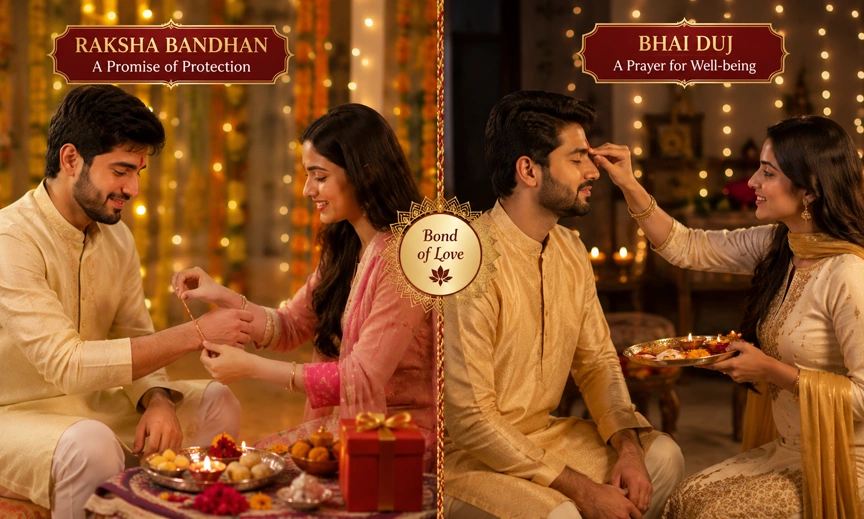
Many people, especially younger generations, often confuse Raksha Bandhan with Bhai Dooj because both festivals celebrate the relationship between brothers and sisters. Although they share similar emotions of love, blessings, and family togetherness, they have different origins, rituals, and cultural significance. Understanding these differences helps us appreciate the unique place that Raksha Bandhan history holds in India’s rich festival calendar.
Raksha Bandhan is celebrated on the full moon day (Purnima) of the Hindu month of Shravan, typically falling in August. The central ritual involves a sister tying a sacred rakhi around her brother’s wrist while praying for his health, prosperity, and happiness. The brother, in return, offers gifts and promises lifelong love, support, and protection. The ceremony revolves around the symbolic thread, which represents trust, responsibility, and an enduring emotional bond.
Bhai Dooj, on the other hand, is observed during the festival of Diwali, usually two days after the Festival of Lights. Instead of tying a rakhi, the sister welcomes her brother with a traditional aarti, applies a ceremonial tilak on his forehead, and prays for his long life. Brothers visit their sisters’ homes, share festive meals, and exchange gifts. While both festivals honour sibling relationships, Raksha Bandhan emphasises the sacred thread, whereas Bhai Dooj focuses on blessings through the tilak ceremony.
Interestingly, both celebrations draw inspiration from the legendary bond between Yama and Yamuna, reinforcing the timeless values of affection, gratitude, and mutual care. Together, they demonstrate how Indian traditions celebrate family relationships through different customs across the year.
The Spiritual Significance of the Rakhi Thread
To many people, a rakhi may appear to be a colourful decorative bracelet made from silk, cotton, beads, or handcrafted ornaments. However, its deeper meaning extends far beyond its appearance. Throughout Raksha Bandhan history, the sacred thread has represented blessings, commitment, and the invisible bond that connects two people through love and responsibility.
In Hindu philosophy, a thread often symbolises continuity and connection. Just as individual strands are woven together to create strength, families are held together through trust, compassion, and shared responsibilities. When a sister ties a rakhi, she is not simply performing a ritual; she is expressing prayers for her brother’s well-being while reaffirming the family’s emotional bond.
Equally important is the brother’s response. Traditionally, he accepts the rakhi with gratitude and pledges to stand beside his sister during life’s challenges. In modern families, this commitment is increasingly viewed as mutual rather than one-sided. Sisters support their brothers emotionally, professionally, and personally, reflecting the changing dynamics of contemporary Indian society while preserving the festival’s timeless spirit.
Many people also tie rakhis to cousins, close friends, teachers, neighbours, and even members of the armed forces as a gesture of respect and goodwill. This broader interpretation reminds us that the festival celebrates meaningful relationships built on trust rather than only biological connections.
Raksha Bandhan 2026: Date, Muhurat and Special Significance
Raksha Bandhan in 2026 will be celebrated on Friday, 28 August 2026, coinciding with the full moon day of the Shravan month according to the Hindu lunar calendar. As with every year, families will look for the most auspicious time (Shubh Muhurat) to perform the rakhi ceremony after considering traditional Panchang calculations.
Many devotees also check whether the period of Bhadra overlaps with the festival. According to Hindu beliefs, tying a rakhi during Bhadra is generally avoided because it is considered inauspicious for certain ceremonies. For this reason, families often consult a reliable Panchang or temple calendar before beginning the rituals.
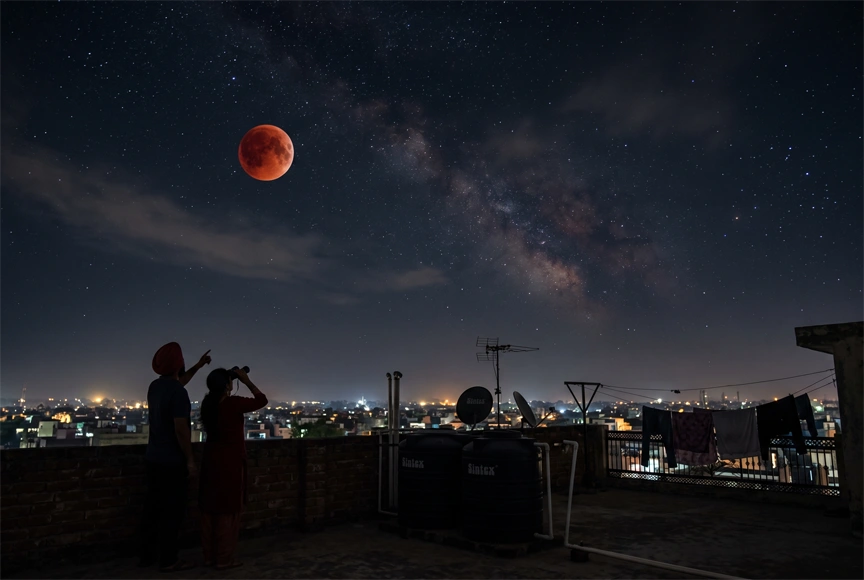
Questions also arise whenever astronomical events such as a lunar eclipse coincide with major festivals. If such an event is predicted, religious authorities typically issue guidance regarding temple timings and ritual observances. Since astronomical calculations can occasionally be refined closer to the date, devotees are advised to verify the final muhurat using an updated Panchang before the festival.
Why the Festival Remains Relevant Today
Despite rapid technological progress and changing lifestyles, Raksha Bandhan continues to bring families together across generations. Brothers and sisters separated by cities or continents exchange rakhis through courier services, online shopping platforms, and video calls. Digital celebrations may look different from traditional family gatherings, but the emotions remain unchanged.
This remarkable ability to adapt explains why Raksha Bandhan history continues to inspire millions of people around the world. From ancient Vedic rituals and mythological legends to modern celebrations connected through technology, the festival has preserved its essential message: relationships grow stronger when they are nurtured with love, respect, gratitude, and unwavering support.
Raksha Bandhan History Beyond India: How the Festival Connects Families Worldwide
One of the most remarkable chapters in Raksha Bandhan history is its journey beyond the borders of India. As Indians migrated to different parts of the world over the last century, they carried with them not only their language and cuisine but also their festivals and family traditions. Today, Raksha Bandhan is celebrated with equal enthusiasm in countries such as the United States, Canada, the United Kingdom, Australia, Singapore, the United Arab Emirates, South Africa, and many other nations where vibrant Indian communities have settled.
For families living abroad, Raksha Bandhan History serves as a meaningful reminder of their cultural roots. Although they may be thousands of kilometres away from their hometowns, the simple act of tying a rakhi helps preserve traditions that have been passed down through generations. Indian associations, temples, and cultural organisations frequently organise community celebrations where families gather to perform rituals, enjoy traditional food, and introduce younger generations to the significance of the festival.
Children born outside India often learn about Raksha Bandhan through family stories rather than textbooks. Parents and grandparents explain the legends of Yama and Yamuna, Krishna and Draupadi, and other tales associated with the festival, helping young members of the family understand that a rakhi represents much more than a decorative thread. It symbolises love, responsibility, gratitude, and lifelong support.
Technology Has Changed the Celebration, Not the Emotion
The digital age has transformed the way families celebrate Raksha Bandhan, especially when siblings live in different cities or countries. Online shopping platforms now allow sisters to send beautifully designed rakhis and personalised gifts anywhere in the world within a few days. Courier companies experience a significant rise in deliveries during the weeks leading up to the festival, ensuring that rakhis reach their destinations before the auspicious day.
Video calls have also become an integral part of modern celebrations. Many sisters perform the traditional aarti while connected through smartphones or laptops, and brothers receive their blessings virtually before opening the rakhi package delivered earlier. Although technology cannot replace a warm family embrace, it enables loved ones to celebrate together despite geographical distances.
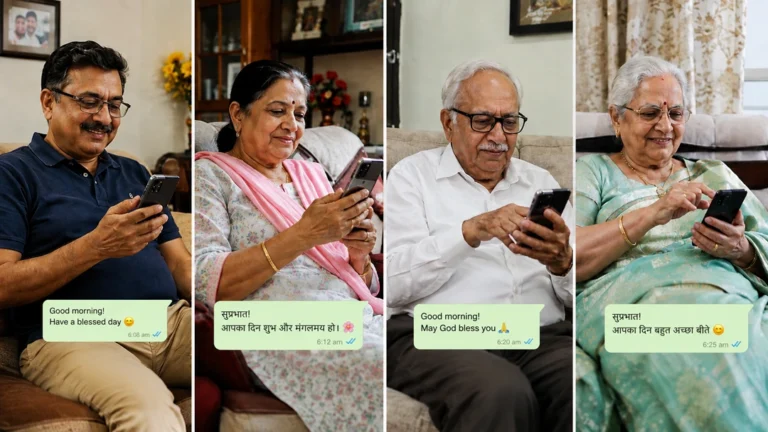
Social media has added another dimension to the festival. Families share photographs, childhood memories, heartfelt messages, and short videos celebrating their bond. These online interactions have helped younger generations appreciate the emotional significance of Raksha Bandhan while also inspiring people from different cultures to learn about the festival.
How Raksha Bandhan Has Evolved in Modern India
Like every living tradition, Raksha Bandhan has adapted to changing times while preserving its core values. Earlier, most rakhis were handmade using cotton threads, silk, rice grains, and simple decorative materials available at home. Today, markets offer an astonishing variety of designs ranging from handcrafted artisan rakhis and eco-friendly seed rakhis to silver, sandalwood, personalised photo rakhis, and cartoon-themed rakhis for children.
Environmental awareness has also influenced modern celebrations. Many families now prefer biodegradable rakhis made from natural fibres, recycled paper, bamboo, jute, or plantable seeds that grow into herbs or flowers after use. This thoughtful approach combines tradition with sustainability, encouraging celebrations that are kinder to the environment.
Gift-giving has evolved as well. While sweets and envelopes containing cash remain popular, many siblings now exchange books, plants, handcrafted products, charitable donations, travel experiences, or personalised keepsakes that create lasting memories. These choices reflect changing lifestyles while preserving the spirit of generosity that has always been part of the festival.
Celebrating Every Meaningful Relationship
Another significant development in recent decades is the broader interpretation of Raksha Bandhan. Although the festival traditionally celebrates brothers and sisters, many people now tie rakhis to cousins, close friends, mentors, teachers, neighbours, and even healthcare workers or members of the armed forces as a mark of respect and gratitude.
Schools, colleges, and social organisations frequently organise Raksha Bandhan programmes that promote harmony, unity, and compassion. Students exchange rakhis regardless of caste, religion, or regional background, demonstrating that the festival’s deeper message extends beyond family relationships. These initiatives reflect the enduring values that have shaped Raksha Bandhan history for centuries—trust, kindness, responsibility, and mutual respect.
Whether celebrated in a small Indian village, a bustling metropolitan city, or a distant country across the globe, Raksha Bandhan continues to remind people that relationships flourish when they are nurtured with sincerity, empathy, and unwavering support. This timeless message explains why the festival remains one of the most beloved occasions in Indian culture and continues to inspire new generations every year.
Frequently Asked Questions About Raksha Bandhan History
1. What is the real history of Raksha Bandhan?
The history of Raksha Bandhan dates back to the Vedic period, where priests tied a Raksha Sutra (sacred protective thread) during religious ceremonies while chanting Vedic mantras for protection and prosperity. Over time, this ancient ritual blended with mythological stories such as those of Yama and Yamuna, Indra and Indrani, and Krishna and Draupadi. These traditions gradually evolved into the modern festival that celebrates the bond of love, trust, and lifelong support between siblings.
2. Who started Raksha Bandhan?
There is no single historical person credited with starting Raksha Bandhan. The festival developed gradually over thousands of years through Hindu religious practices, mythology, and regional customs. Its evolution reflects India’s rich cultural heritage rather than one specific event or founder.
3. Which story is most closely associated with Raksha Bandhan?
Several legends are linked to the festival, but the most popular include the stories of Yama and Yamuna, Krishna and Draupadi, and Indra and Indrani. The tale of Rani Karnavati and Mughal Emperor Humayun is also widely known, although historians continue to debate its historical authenticity.
4. Why do sisters tie a rakhi?
Sisters tie a rakhi as a symbol of love, blessings, and prayers for their brother’s health, happiness, and success. The thread also represents mutual trust and emotional support. In modern families, the festival celebrates shared responsibility, recognising that brothers and sisters protect and encourage one another throughout life.
5. Is Raksha Bandhan mentioned in the Vedas?
While the present-day sibling festival is not described exactly as it is celebrated today, Vedic literature refers to the Raksha Sutra, a sacred protective thread tied during religious rituals. This ancient practice is widely regarded as one of the earliest foundations of Raksha Bandhan history.
6. Is Raksha Bandhan celebrated only in India?
No. Today, Raksha Bandhan is celebrated by Indian communities around the world, including in the United States, Canada, the United Kingdom, Australia, Singapore, the United Arab Emirates, South Africa, and many other countries. Families living abroad continue the tradition through community events, courier services, and virtual celebrations.
7. What is the significance of the rakhi thread?
The rakhi symbolises protection, affection, gratitude, and commitment. More than a decorative thread, it represents the emotional bond between two people and the promise to stand by one another during both joyful and difficult times.
8. How is Raksha Bandhan different from Bhai Dooj?
Raksha Bandhan is celebrated during the full moon of the Shravan month and centres on tying a sacred thread. Bhai Dooj is observed after Diwali and focuses on the sister applying a ceremonial tilak to her brother’s forehead. Although both festivals celebrate sibling relationships, their rituals, timing, and historical traditions are different.
9. Why is Raksha Bandhan still important today?
Despite changing lifestyles, Raksha Bandhan history continues to strengthen family relationships by encouraging gratitude, respect, and lifelong support. Modern celebrations may include online gift deliveries and video calls, but the emotional meaning of the festival remains as relevant as ever.
10. What can we learn from Raksha Bandhan history?
The enduring lesson of Raksha Bandhan history is that meaningful relationships thrive through trust, compassion, responsibility, and mutual respect. The festival reminds us that genuine protection is expressed not only through promises but also through everyday acts of kindness, encouragement, and unwavering support.
Conclusion
Raksha Bandhan history is a remarkable journey through India’s spiritual, cultural, and social evolution. From the ancient Vedic tradition of the Raksha Sutra to beloved mythological legends and medieval folklore, the festival has continually adapted to changing times while preserving its essential message of love and protection.
What makes Raksha Bandhan truly special is its ability to unite people across generations, regions, and even national boundaries. Whether celebrated in a traditional Indian home, a bustling city apartment, or a family living thousands of kilometres away from India, the sacred thread continues to symbolise trust, gratitude, and lifelong relationships.
Today, Raksha Bandhan is no longer viewed solely as a festival where brothers promise to protect their sisters. It has grown into a celebration of mutual respect, emotional support, equality, and shared responsibility. Brothers and sisters inspire one another, stand together during life’s challenges, and celebrate each other’s achievements, making the festival more meaningful than ever before.
As India continues to embrace modern lifestyles and digital connectivity, the traditions surrounding Raksha Bandhan evolve without losing their cultural roots. Handmade rakhis now coexist with eco-friendly designs, courier deliveries, and virtual ceremonies, proving that while customs may change, the emotions behind them remain timeless.
Ultimately, the enduring legacy of Raksha Bandhan history lies in its simple yet powerful message: relationships are among life’s greatest blessings, and they flourish when nurtured with love, trust, gratitude, and compassion. Every rakhi tied is more than a ritual—it is a heartfelt reminder that the strongest bonds are woven not from thread alone, but from care, understanding, and unwavering support.
Key Takeaways
Raksha Bandhan history traces its origins to ancient Vedic traditions centred around the sacred Raksha Sutra.
Mythological legends involving Indra and Indrani, Yama and Yamuna, and Krishna and Draupadi shaped the festival’s cultural identity
The famous story of Rani Karnavati and Humayun remains an important cultural legend, though historians debate its historical accuracy.
The festival continues to connect families across the world, proving that its timeless values remain relevant in every generation.