Millets glycemic index is one of those phrases that suddenly pops up everywhere when someone in the family gets prediabetes, sugar, or a doctor’s strict food list. I have seen this happen at my own dining table in Delhi, where one cousin swapped rice for millet rotis and felt very proud, only to discover later that not every millet behaves the same in the body. That is the real story here. The millets glycemic index is not one neat low number for all grains, and once you understand that, the whole conversation changes.
I remember hearing the same line again and again in markets and WhatsApp groups: ‘Millets are low GI, so they are always better.’ However, that is only partly true. Some millets are genuinely friendly for blood sugar, while others sit much closer to white rice than people assume. This matters because in India, we are not just choosing food. We are choosing what fits our taste, budget, family habits, and health goals. If you want a broader healthy-eating context, I also like this practical guide on healthy food habits.
In this article, I am going to break down the millets glycemic index honestly, without the usual marketing glow. We will talk about bajra, ragi, jowar, and the lesser-known millets that actually deserve the low-GI praise. Moreover, we will look at why the better grains often cost more, and why farmers do not grow them as much. That is where the real India story sits. If you have ever wondered why a millet atta packet feels pricier than regular flour, or why your sugar readings did not improve after switching, this piece is for you. I am keeping it practical, human, and very Indian, because food is never just nutrition in our homes. It is memory, comfort, and routine. You may also enjoy these nostalgic ideas at nostalgic Indian comfort food recipes.
Millets glycemic index begins with one simple question: how quickly does a food raise blood sugar after you eat it? The glycemic index, or GI, measures that rise compared with pure glucose. Foods with a high GI digest fast and can spike sugar more sharply. Foods with a low GI digest more slowly, which is why they are often preferred for diabetes control. That sounds straightforward, but in real life the answer depends on cooking style, portion size, and what you eat with the grain.
Millets glycemic index And Portion Reality
Millets glycemic index is only one part of the story because a food can be low GI and still raise sugar if the portion is huge. A small bowl of cooked millet with dal and sabzi behaves very differently from a large plate of millet khichdi with potatoes. The same grain can also change in GI after heavy milling, fine grinding, or pressure cooking for too long. That is why my advice is never to read a millet label in isolation. Think about the whole meal, not just the grain.
Why GI Is Useful But Not Perfect
Millets glycemic index helps you compare grains, but it does not capture everything. It does not fully reflect fiber, resistant starch, protein, or the way your body personally reacts. Two people can eat the same millet and see different sugar responses. A person walking after dinner may handle the meal better than someone sitting immediately after. The WHO notes that diabetes remains a major global health issue, and dietary patterns matter greatly, so GI is useful as a guide, not a magic badge. You can read more from the World Health Organization diabetes fact sheet. In short, millets glycemic index is a tool, not a promise.
The Millet Myth Everyone Repeats
Millets glycemic index is often sold with one lazy line: all millets are low GI. That is the myth. I hear it in ads, in health reels, and even from people who have never checked a number in their life. The truth is more interesting. Some millets are moderate, some are truly low, and some are nowhere near the superfood image they get online. When people say ‘millets are always better than rice,’ they are usually mixing nutrition with marketing.
How The Myth Spread In India
Millets glycemic index became a trendy phrase when people started looking for alternatives to polished rice and refined wheat. That was a useful shift, especially for urban India where sedentary routines are common. But then every millet got pulled into the same bucket. Bajra roti, ragi malt, jowar bhakri, and tiny indigenous grains were all treated as if they had the same body response. They do not. In Delhi, I have seen health stores sell expensive millet mixes as if the label alone makes them medicinal. It does not.
What The Label Usually Hides
Millets glycemic index is not always printed on packaging, so shoppers rely on buzzwords like ‘diabetic friendly’ or ‘low GI’. That is risky. Some packs contain a small amount of millet mixed with rice flour or starch-heavy ingredients, which changes the actual effect. Moreover, fine milling can raise GI compared with whole-grain forms. If you want comfort food comparisons, it helps to remember that food behaves differently when it is puffed, ground, or overcooked. The myth survives because it is simple, and nutrition is rarely simple. If you want to avoid common food mistakes, this health article on deficiency symptoms is also worth a read for the bigger wellness picture.
GI Value Of Every Common Millet
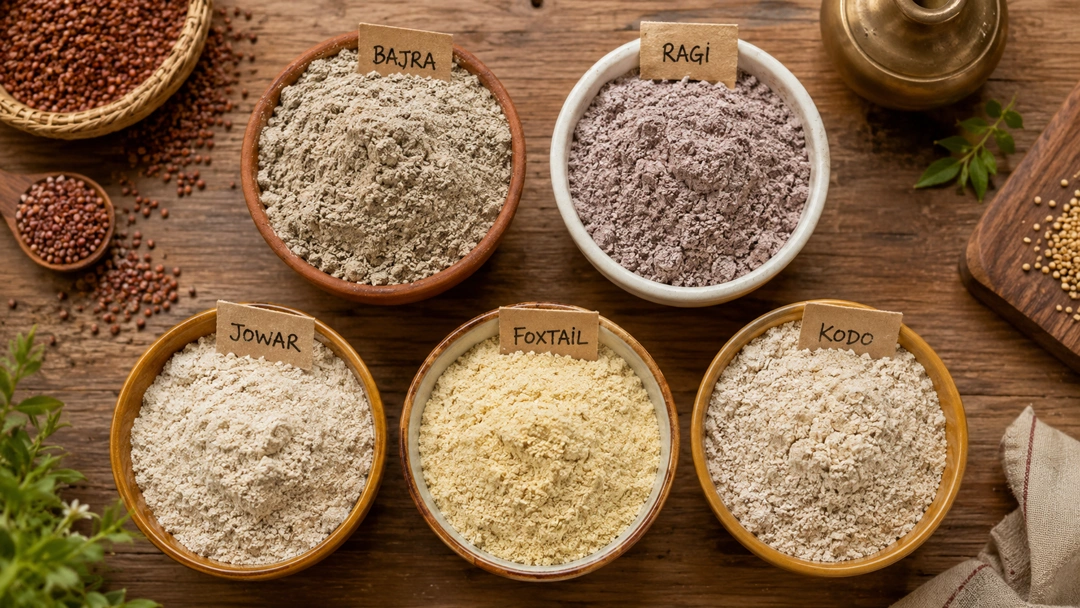
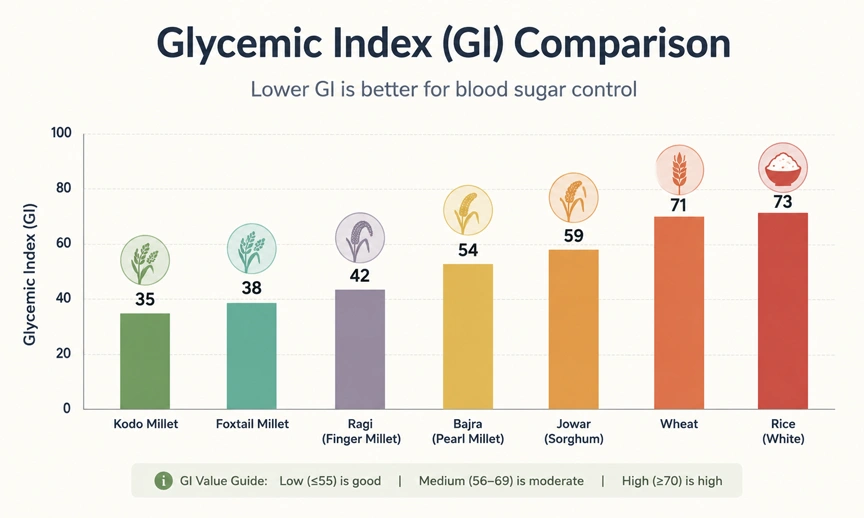
Millets glycemic index becomes clearer when you stop talking in generalities and look at the grains one by one. Jowar is often treated as the default healthy millet, but it is not automatically the lowest. Bajra and ragi are popular in Indian kitchens, yet their GI values are not always as friendly as people expect. By contrast, some lesser-known millets from the Siridhanya group are the real low-GI standouts. That is the part most people miss.
Common Indian Millets And Their Range
Millets glycemic index can vary by preparation, but rough ranges help. Jowar is usually moderate and often lands around the same broad zone as better-quality rice depending on form and cooking. Bajra can also sit in the moderate range rather than the low range people assume. Ragi, despite its rich calcium image, can behave closer to white rice in GI terms when processed as a fine flour or cooked as a soft porridge. Foxtail millet and little millet often fare better. Barnyard millet and kodo millet are also among the more blood-sugar-friendly choices.
Why One Number Is Not Enough
Millets glycemic index should never be used like a grade sheet where low means good and high means bad. Cooking method matters. A fermented batter, a coarse flour, or a lightly cooked grain can behave differently from instant porridge. In Indian homes, we also pair grains with curd, chutney, dal, and vegetables, which changes the meal’s overall response. So yes, the number matters, but the recipe matters too. That is why someone saying ‘I eat millet, so my sugar is fixed’ may be oversimplifying the issue. The grain is only one part of the plate, not the whole cure.
Why Bajra And Ragi Are Not Low GI
Millets glycemic index is where bajra and ragi disappoint many well-meaning buyers. Bajra is healthy in other ways, and ragi has a strong nutrient profile, but neither automatically belongs in the true low-GI club. People often assume anything traditional must be diabetes-friendly. However, tradition and blood sugar response are not the same thing. This is one of the most important corrections in the millet conversation.
Why Bajra Can Act Like White Rice
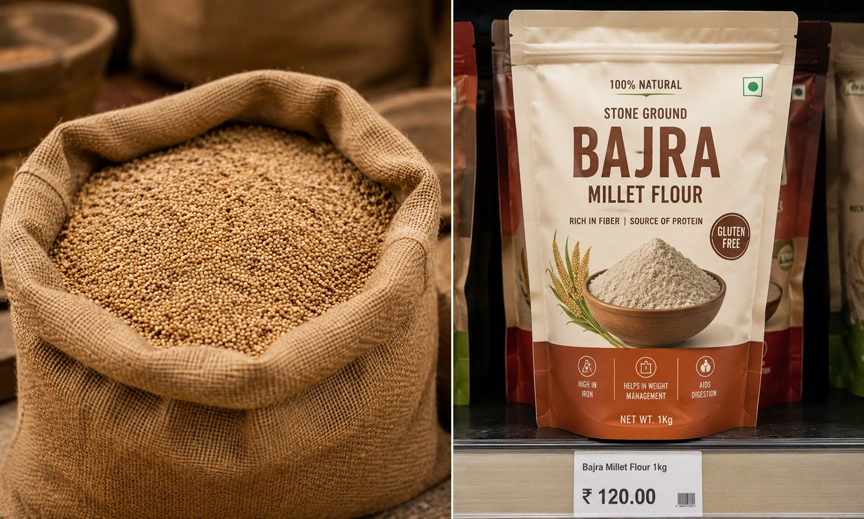
Millets glycemic index for bajra depends on the form, but bajra roti made from fine flour can raise sugar more than expected. When the flour is too soft or the roti is eaten without enough protein, the meal absorbs quickly. That does not make bajra bad. It simply means the health claim is incomplete. In my Delhi home, bajra rotis are often paired with sarson ka saag or chana, and that pairing makes more sense than eating them alone. The context matters more than the label.
Why Ragi Is Not The Magic Answer
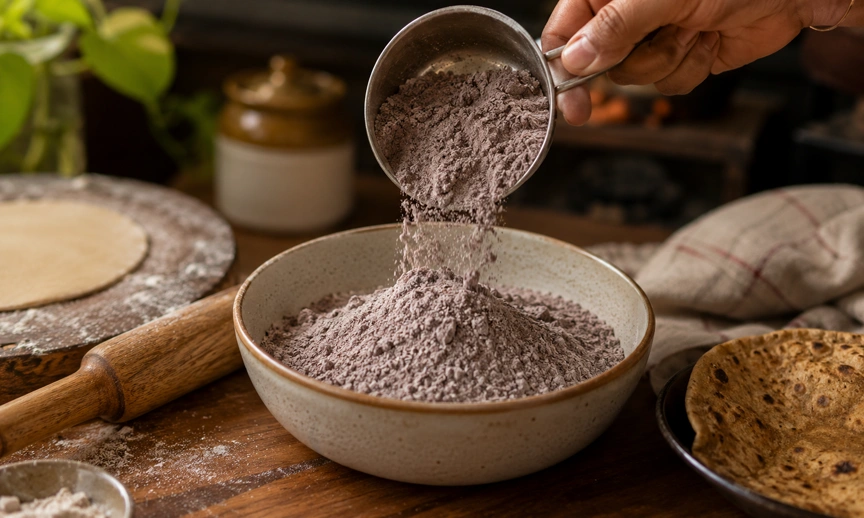
Millets glycemic index for ragi surprises many people because ragi is widely marketed as ideal for everyone, especially diabetics and children. But ragi flour is often very fine, and fine flour can digest quickly. Ragi malt with jaggery is especially tricky for sugar control. I have seen people drink it as a health drink and then wonder why they still feel hungry soon after. Ragi is nutritious, yes. But nutritious and low GI are not the same sentence. That distinction matters if you are managing diabetes or trying to avoid sugar spikes. If you want a sensible food routine, think meal balance first and marketing second.
Why Farmers Grow Less Millet Each Year
Millets glycemic index is not just a nutrition question. It is also an agriculture question. If the better low-GI millets are harder to find, there is a reason. Farmers respond to market demand, irrigation realities, procurement support, and yield stability. When a crop is harder to sell or process, people grow less of it. That is the hidden reason behind scarcity on shelves. The grain story begins far before your kitchen.
What Makes Farming These Grains Tough
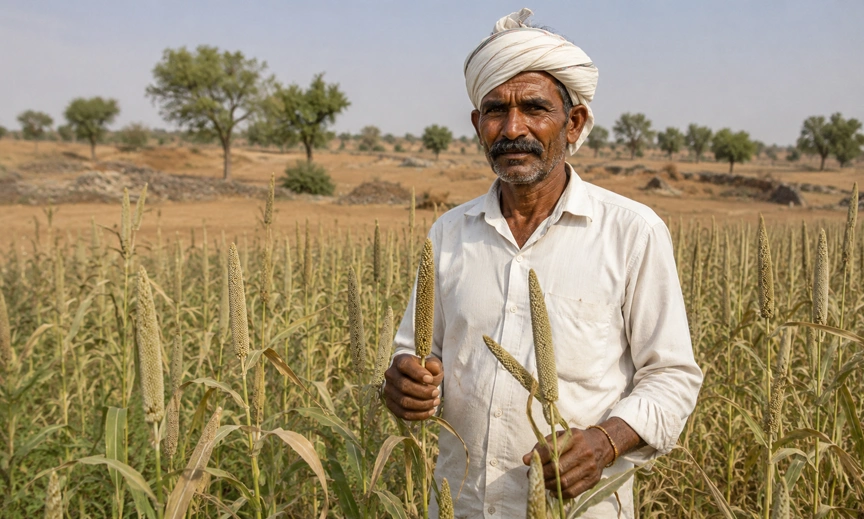
Millets glycemic index is one part of why health buyers want these grains, but farm decisions are driven by risk. Many lesser-known millets need better sorting, cleaning, and processing support. They are not as widely mechanized as wheat or rice. Some also fetch inconsistent prices at market. Meanwhile, quick-turnover crops offer easier cash flow for small farmers. In dry regions of Rajasthan, Telangana, Karnataka, and Maharashtra, millets still matter, but acreage rises and falls based on whether the farmer can actually earn from them.
Why Supply Is So Uneven In Cities
Millets glycemic index searches have grown in Delhi and other metros, yet supply chains have not fully caught up. That is why the truly good grains sometimes appear only in specialty stores or online packs. Farmers may be growing them, but aggregation, cleaning, grading, and branding remain weak. So the consumer sees a premium product, while the farmer may still be stuck with thin margins. This gap explains why some millet products feel like boutique food instead of everyday staples. A healthier food future needs both consumer demand and farm-level support, not just social media praise.
The Real Cost Behind Premium Millet Atta
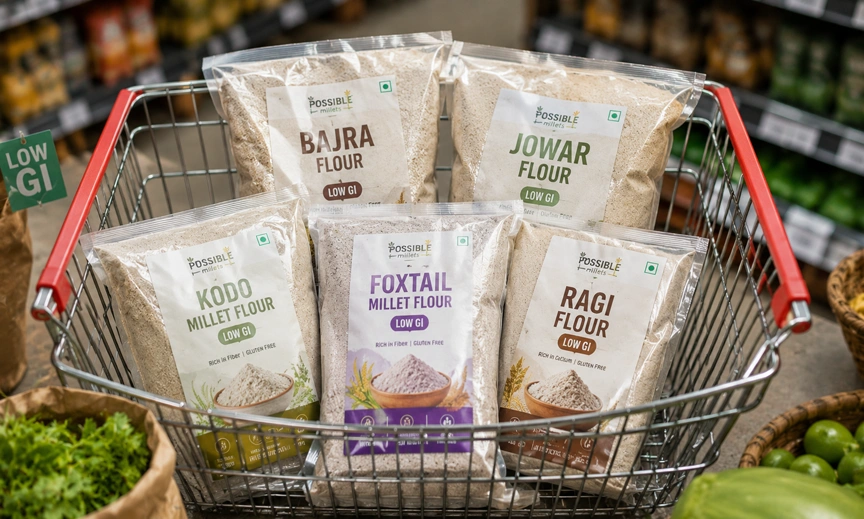
Millets glycemic index is often used to justify expensive atta, but price is about more than health branding. Premium millet flour costs more because the raw grain is costlier to source, harder to clean, and often produced in smaller batches. Add packaging, retail margin, and transport, and the number rises quickly. That is why a bag that looks modest can still feel premium at checkout.
Why Small-Batch Milling Raises Price
Millets glycemic index is most useful when the grain is whole or minimally processed, but that also means milling is not as cheap as mass wheat production. Small mills clean, sort, and grind limited quantities. The machinery may need more maintenance because millet grains vary in size and hardness. Moreover, lower supply means less bargaining power. In Delhi, I have seen genuine low-GI millet flours cost significantly more than regular atta, which makes families hesitate. That hesitation is understandable. For many households, food must fit both the sugar meter and the monthly budget.
What You Are Really Paying For
Millets glycemic index premium pricing is partly real value and partly brand storytelling. You may be paying for cleaner processing, better grain selection, organic claims, or just a fashionable label. The challenge is telling the difference. If a pack only says ‘multigrain’ and ‘diabetic friendly’ without naming the grain percentages, be careful. Higher price does not always equal better nutrition. Sometimes it only means better packaging. Still, there is a real cost to growing, sorting, and transporting the best low-GI millets. That cost lands in your kitchen eventually. The question is whether the product earns its price, not whether the label sounds healthy.
The 5 Millets That Are Genuinely Low GI
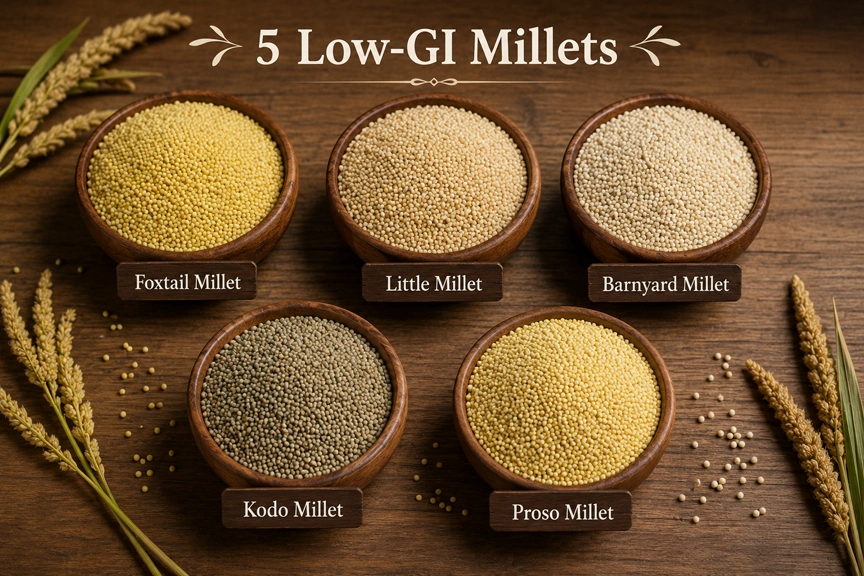
Millets glycemic index finally becomes useful when we name the grains that truly stand out. The five that generally deserve the low-GI praise are foxtail millet, little millet, barnyard millet, kodo millet, and proso millet. These are the grains many Indian nutrition discussions should focus on more often. They are not always the easiest to find, but they are the ones that most closely match the promise people assume all millets offer.
Siridhanya Millets Explained Simply
Millets glycemic index fans often use the term Siridhanya for a group of low-GI millets, usually including foxtail, little, barnyard, kodo, and browntop millet in some traditions. The exact naming can vary by region and brand, which causes confusion. Still, the core idea is simple: these are the millets people reach for when blood sugar control is the priority. They are usually less processed, more fibrous, and slower to digest than many common flour-based alternatives. If you have seen the term on a packet and wondered what it means, now you know.
Which One Should You Choose First
Millets glycemic index alone will not choose for you. Foxtail millet is a good starting point because it is easier to cook and widely accepted in Indian kitchens. Little millet is versatile for upma and pongal style dishes. Barnyard millet works well for fasting-style meals. Kodo millet and proso millet are also strong options if you can find them. My practical suggestion is to start with one grain, test your digestion and sugar response, and then build a rotation. Variety helps. So does patience. Your body often responds better when you make food changes gradually instead of dramatically.
How To Actually Cook Low GI Millets
Millets glycemic index improves or worsens depending on how you cook. That is the part many people skip. A low-GI grain can become less friendly if you overcook it into a soft mush or turn it into a fine porridge with sugar. The good news is that Indian kitchens already know how to make grain-based meals with balance. We just need to apply that habit more carefully.
Simple Cooking Rules That Help
Millets glycemic index responds well to gentle cooking, soaking, and pairing with protein and vegetables. Soak whole grains when possible. Avoid turning everything into instant flour-based porridge. Keep the texture a little firm, just like you would for pulao rice. Add dal, curd, paneer, peanuts, or sprouts to slow the meal down. In my own Delhi routine, a millet bowl with sabzi and curd keeps me fuller far longer than a millet chilla with sweet chutney. The meal composition matters as much as the grain itself.
Indian Meal Pairings That Work Better
Millets glycemic index works best when the meal is built like a balanced Indian thali. Think millet bhakri with chana, foxtail millet khichdi with vegetables, or little millet upma with peanuts and curry leaves. Avoid making every millet dish sweet by default. That is a common mistake, especially with ragi. If you want a comfort angle, use spices and tempering instead of sugar-heavy shortcuts. Home-style food can still be healthy. It does not need to taste clinical. It only needs to be thoughtful.
Reading Millet Labels Without Getting Fooled
Millets glycemic index can be easily misused in packaging. That is why label reading matters. A pack may say ‘healthy’, ‘natural’, or ‘high fiber’, but those words mean very little unless the ingredient list tells the real story. Many products use millet as a selling point while quietly mixing in refined flour, starch, or sugar. In India, that happens more often than consumers realize.
What To Check On The Pack
Millets glycemic index claims are only useful if the pack names the exact millet and its percentage. Look for whole grain or coarse grain rather than ultra-fine flour. Check whether the product has added sugar, maltodextrin, or rice flour. Also see if the company mentions preparation instructions that keep the grain less processed. If it is a ‘multigrain’ product, do not assume millet dominates the mix. The word can hide a lot. When in doubt, choose simpler products with shorter ingredient lists.
Packaged Multigrain Is Not Always Healthy
Millets glycemic index can be diluted inside a multigrain mix that is mostly wheat or starch. That is why packaged ‘healthy atta’ deserves skepticism. Some brands use millet in a small percentage just to borrow the health halo. Others are genuinely better, but you need to verify. My Delhi rule is simple: if the front label sounds too perfect, turn the pack over and read the back. Real health food usually looks less glamorous and more ordinary. That is often a good sign, not a bad one.
Frequently Asked Questions
Is Bajra Good For Diabetics?
Millets glycemic index for bajra is not as low as many people think, so bajra is not a magic diabetes food. It can still fit into a diabetic diet when portion size is controlled and when it is paired with protein, vegetables, or dal. A bajra roti with saag is very different from several rotis eaten alone. If you monitor sugar at home, observe your personal response after eating.
What Is The Glycemic Index Of Ragi?
Millets glycemic index for ragi is often more moderate than low, especially when ragi is finely milled or made into sweet porridge. Ragi is nutrient-rich, but that does not automatically make it blood-sugar friendly. The way it is cooked matters a lot. A ragi dosa with protein sides may behave better than sweet ragi malt. Always look at the full meal, not the grain alone.
Which Millet Has The Lowest Glycemic Index?
Millets glycemic index is usually best among foxtail millet, little millet, barnyard millet, kodo millet, and proso millet. These are the grains most often described as genuinely low GI. Exact numbers still vary by cooking and processing, so no single millet is perfect in every form. If you want a safer starting point, try a small portion of foxtail or little millet and track how your body feels.
Is Jowar Better Than Rice For Diabetes?
Millets glycemic index for jowar is often better than polished white rice, but not always dramatically better. The form of the grain, the flour fineness, and the meal combination matter. Jowar bhakri can be a better option than plain white rice for many people, especially if eaten with dal and vegetables. However, it should still be treated as part of a balanced plate, not a free pass.
Why Is Millet Atta So Expensive In India?
Millets glycemic index is part of the sales pitch, but millet atta is expensive mostly because sourcing, cleaning, milling, packaging, and transport cost more for smaller batches. The best low-GI grains are not produced at the scale of wheat or rice. That means the price reflects limited supply, extra processing, and premium branding. Sometimes the cost is fair. Sometimes it is just clever marketing.
What Are Siridhanya Millets?
Millets glycemic index discussions often mention Siridhanya millets, which usually refers to a group of low-GI grains such as foxtail, little, barnyard, kodo, and sometimes browntop millet. The exact grouping can vary slightly by source and region. The phrase became popular in Indian wellness circles because these grains are often favored for slower digestion. If you buy them, check the exact grain name, not just the category term.
Can Millets Replace Rice Completely?
Millets glycemic index can make millets a better everyday choice than rice for some people, but complete replacement is not necessary for everyone. Taste, digestion, family habits, and budget all matter. Many Indian households do well with a rotation of rice, millets, dals, and other grains instead of a strict switch. For diabetes, the best plan is the one you can sustain without feeling deprived or confused.
How Much Millet Should A Diabetic Eat Daily?
Millets glycemic index is only one factor, and daily quantity depends on the person, medicines, activity level, and sugar readings. A diabetic should not assume millet can be eaten in unlimited amounts just because it is traditional. A sensible portion is usually one serving of grain within a balanced meal, but your doctor or dietitian should guide the exact amount. Personal response matters more than internet rules.
Are Packaged Multigrain Atta Brands Actually Healthy?
Millets glycemic index can be weakened by packaged multigrain blends that contain only a small amount of millet and a lot of refined ingredients. Some brands are genuinely useful, but many are just better marketed than nutritious. Read the ingredient list carefully. If millet is not the first or dominant ingredient, do not treat the product as a health food. Simpler packs are often the safer choice.
Is Foxtail Millet Safe For Daily Consumption?
Millets glycemic index for foxtail millet is one reason many people use it daily, and for most healthy adults it is safe in normal portions. Still, variety is wise. Eating one grain every day without rotation can make meals repetitive and may not give you the broadest nutrient mix. If you have diabetes, kidney issues, or digestive problems, speak to a professional before making it your only staple.
Conclusion
Millets glycemic index is worth learning properly because it can save you from a very common mistake: assuming every millet is automatically low GI and equally helpful. Once you see the difference between bajra, ragi, and the truly low-GI grains like foxtail, little, barnyard, kodo, and proso, the whole subject becomes clearer. I like that clarity. It feels respectful to both science and the Indian kitchen.
From my Delhi perspective, the best food choices are rarely dramatic. They are practical. They fit family habits, budget, and everyday life. That is why I would rather have you choose one genuinely low-GI millet, cook it well, and pair it sensibly than buy every shiny packet that says healthy on the front. If you are rebuilding your meals, start small, observe your sugar response, and keep the focus on consistency. You can also support the bigger wellness picture by reading healthy food habits alongside your grain choices.
Millets are not a miracle, and they are not a fraud either. They are food, with all the nuance that food deserves. The more honestly we talk about them, the better our plates and our decisions become. Millets glycemic index.