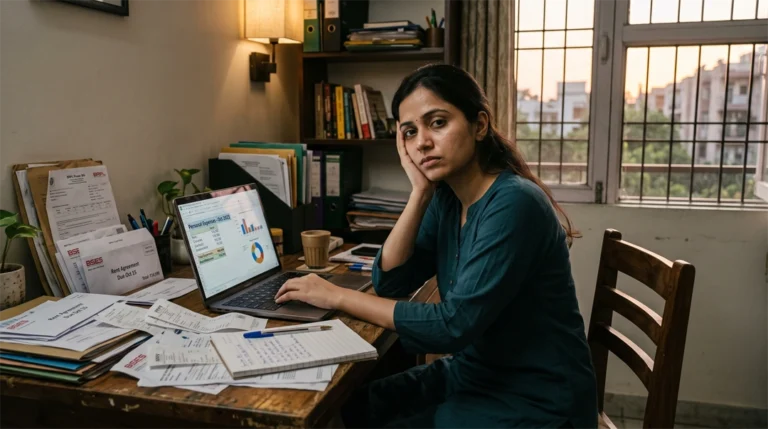
Have you ever wondered why middle class India savings seem elusive despite higher incomes? I find myself pondering this paradox each time I chat with friends over chai in Delhi. The streets bustle with professionals like my neighbor Rohan, who earns significantly more than his father ever did. Yet, like so many of us, he finds saving difficult. It’s something that hits close to home—it’s not just about individual choices; it’s a deeper economic and social script we’re all navigating. In exploring this, I aim not to blame anyone, but to decode these systemic challenges we face. What about you? What does saving mean in your world? This is what I’ve discovered living in the heart of India.
Explore more about this in self-improvement burnout India hustle culture https://picknstory.com/self-improvement-burnout-india-hustle-culture
The Salary Illusion – Why More Money Feels Like Less
In middle class India savings stories, there’s often a recurring theme: the salary illusion. As incomes rise, so do expenses, making it seem as if extra earnings quickly evaporate. Many urban Indians experience this, especially in cities like Delhi where the cost of living can escalate rapidly. What appears to be a pay increase turns into a game of catch-up with inflating prices, high rentals, and elevated lifestyle expectations.
The Rising Cost of Living
Even though salaries have increased, the fast-rising cost of living eats into these increments. Housing, utilities, and everyday expenses seem to rise faster than paychecks, leaving little room for genuine growth in middle class India savings. For instance, the rent for a modest apartment in a decent Delhi neighborhood itself can consume a third of one’s salary.
The Perception of Wealth
Interestingly, with bigger salaries comes the pressure to maintain a certain lifestyle. Higher salaries are often perceived as wealth, pushing people to make lifestyle choices that suppress savings. Gifting practices, dining out, and technology upgrades—these are seen as necessities rather than luxuries, especially in a city that never sleeps.
The EMI Economy That Replaced Saving in India
Middle class India savings have transitioned into an EMI-driven financial ecosystem. Loans and installments reign supreme, altering saving habits. The proliferation of easy EMIs to purchase everything from cars to smartphones has fueled this shift, making instant gratification more accessible but savings less likely.
Living on Borrowed Funds
The emergence of the EMI economy creates an illusion of affordability. Many families prioritize immediate desires over future security, committing much of their income to monthly payments. This paradigm shift—from saving for a big purchase to buying on credit—erodes traditional saving methods and jeopardizes potential savings.
The Trap of Financial Comfort
EMIs offer a seeming ease and improvement in quality of life but come at the cost of diminishing middle class India savings. It’s a comforting trap where access to credit creates a false sense of wealth, but at the end of each month, the financial comfort feels more like a delusion. Here’s an insightful piece on [equated monthly installment (EMI)](https://en.wikipedia.org/wiki/Equated_monthly_installment).
The Elder Care Bill Nobody Planned For
The unplanned elder care bill significantly impacts middle class India savings. With aging parents becoming more dependent, the financial support needed takes a chunk of savings away. Caring for elders, while fulfilling familial duties, often extends beyond emotional support—it has a very real financial requirement.
The Unseen Costs
The costs of medical care, regular living expenses, and unexpected hospital visits often strain the finances of many middle-class families. In the absence of robust insurance coverage, these expenses can soar unexpectedly, diverting funds away from potential savings or investments.
The Emotional Aspect
Moreover, the cultural ethos of keeping elders at home adds to the financial burden. The emotional weight of wanting to provide the best for one’s parents, coupled with insufficient government support, means that families often dig deep into their financial reserves.
School Fees – India’s Most Invisible Middle Class Tax
Another invisible drain on middle class India savings is school fees, which have become a substantial financial obligation. The emphasis on quality education drives families to enroll children in private or international schools, where fees are climbing sky-high, often without adequate returns.
The Price of Quality Education
In a country obsessed with education, these fees represent a significant portion of household expenditure. Preparing children for a competitive future, while essential, is taxing on parents’ finances. These costs continue to climb, sometimes outpacing salary increments, leaving limited space for savings.
Rising Ancillary Expenses
Add to that the expenses for coaching, private tuitions, and extracurricular activities, and school fees easily become a tax that goes unacknowledged but is profoundly felt in reducing middle class India savings.
The Wedding Season That Drains a Year’s Savings
For middle class India savings, another major drain comes from wedding seasons, symbolic of India’s rich cultural tapestry but also a significant financial strain. The pressure to conduct lavish weddings often depletes a year’s worth of savings.
The Cultural Expectation
Weddings in India are much more than union ceremonies; they are status symbols and social obligations. Families go above and beyond to impress, often driven by societal expectations, inadvertently burning through their financial resources meant for savings.
The Peer Pressure
The cultural peer pressure in cities like Delhi magnifies this challenge, compelling families to spend beyond their means, further impacting middle class India savings. This often results in long-term financial repercussions as resources are diverted from savings to maintaining appearances.
Real Estate Obsession as a Savings Substitute
There’s a significant portion of middle class India savings driven by an obsession with real estate. Here in Delhi, buying property is seen not only as a status symbol but as the ultimate saving instrument, albeit a risky one.
Understanding the Risk
Real estate is considered a secure investment, yet it often ties up savings in illiquid assets. The emphasis on purchasing property can lead to limited liquidity for emergencies or alternative investments.
The Illusion of Asset Building
This obsession can create an illusion of building wealth, but in the short term, it stresses finances, leading to overlooked opportunities in more flexible financial instruments that potentially offer better returns.
Lifestyle Inflation – When Your Peer Group Sets Your Budget
The middle class India savings struggle is deeply affected by lifestyle inflation, where societal pressures dictate spending patterns. This inflation is subtle but powerful and can erode savings significantly.
The Social Media Effect
In the era of social media, people often feel pressured to outdo or keep up with peers in terms of lifestyle, which can drive overspending. This comparison-driven lifestyle leads to purchases and vacations not necessarily needed but acquired for social standing.
The Subtle Lifestyle Creep
As salaries grow, so do expectations. High-end gadgets, vehicles, and luxury brand purchases often become the norm, continually hampering middle class India savings, as more income is channeled toward maintaining a specific image.
What Actually Works for Indian Middle Class Saving
Amid these challenges, saving strategies do exist for middle class India savings. These strategies begin with awareness and adjustment in spending patterns. Being conscious of social obligations, emergency funds, and prioritizing needs over wants can make a significant difference.
Developing a Budget
Faced with numerous financial commitments, developing a strict budget could be the saving grace for families. Prioritizing savings as part of monthly expenses rather than an afterthought helps in maintaining financial discipline.
Investment in Financial Literacy
Furthermore, increasing financial literacy and awareness about non-conventional saving instruments, such as mutual funds and SIPs, can provide a broader horizon for achieving financial goals. [Learn how to stop procrastinating and improve your financial literacy](https://picknstory.com/stop-procrastinating/).
Building a Savings System That Fits Indian Reality
Creating a sustainable middle class India savings system requires practical and cultural alignment. It involves changing mindsets around financial security, and promoting a structured savings model adapted to Indian realities.
Cultural Shift in Spending Habits
The need for cultural adaptation towards pragmatic financial literacy is crucial. Promoting conversations around personal finance, reducing reliance on EMIs, and integrating global best practices in saving can be transformative.
Family-oriented Financial Planning
Additionally, developing family-oriented financial plans that address specific Indian familial concerns, such as elder care and education, can reshape the savings landscape for the better. Implementing these strategies can ensure that families remain financially robust amid evolving economic challenges.
FAQs
Why is India’s household savings rate declining despite rising incomes? The decline in middle class India savings despite higher incomes is attributed to rising lifestyle costs, increased social obligations, and the popularity of credit-based spending. Increased expenses stemming from education, healthcare, and housing significantly cut into potential savings.
What percentage of income should an urban Indian save each month? Ideally, middle class India savings should be around 20% of an individual’s monthly income. However, this can vary based on personal circumstances, commitments, and financial goals. Prioritizing basic needs and controlling discretionary spending can help achieve this target.
How does India’s EMI culture affect long-term savings? India’s EMI culture adversely affects middle class India savings by diverting disposable income toward servicing debt rather than saving. This reliance on credit can result in fewer long-term savings as monthly installments consume potential savings.
Why do most Indians not have an emergency fund? Many Indians struggle with creating an emergency fund due to unpredictable expenses and prioritizing immediate financial needs over future security. This situation is compounded by a lack of awareness about its importance and how to effectively build one.
Is investing in real estate better than mutual funds for Indian middle class? While real estate is traditionally viewed as a safe investment, it lacks liquidity compared to mutual funds. For middle class India savings, mutual funds provide more flexibility and potentially higher returns over time, making them a viable alternative.
How to save money in India when parents depend on you financially? To manage middle class India savings when parents rely on your income, allocate funds for their needs while ensuring your saving priorities. Setting a realistic budget and exploring investment options that yield returns can support this dual responsibility.
Why do Indian salaries feel inadequate even after promotions? Despite promotions, Indian salaries often feel insufficient due to rising living costs and increased financial commitments. Lifestyle expectations and societal pressures also stretch salaries, affecting middle class India savings.
What is the biggest financial mistake urban Indians in their 30s make? The biggest mistake impacting middle class India savings is living beyond means, often stimulated by societal pressures and lifestyle inflation. Ignoring long-term savings for immediate gratification can hinder financial stability.
How does social pressure around weddings and gifts affect Indian savings? Social pressure in India regarding weddings and gifting leads to increased expenditure that impacts middle class India savings. This expectation to uphold family honor and societal status often results in lavish spending beyond what is economically feasible.
What is the right age to start SIP investments in India? Starting SIP (Systematic Investment Plan) investments early, ideally in the mid-20s, is advisable for enhancing middle class India savings. Early investments benefit from compounding over the years, accumulating significant wealth for future needs. [Understand more about earning through AI and finance management](https://picknstory.com/earn-money-using-ai-in-india/).
Conclusion
Middle class India savings are a challenge, but understanding the systemic issues is crucial in addressing them. From inflated lifestyles to societal pressures, my life in Delhi has shown that these are deep-rooted issues. Yet, with financial literacy and a shift in cultural practices, change is possible. Let’s work towards building a financial future that embraces realistic saving measures and creates stability for our families. After all, middle class India savings hold the potential to transform our collective futures, if we begin addressing it today.
Look into more ways to balance your lifestyle and savings https://picknstory.com/self-improvement-burnout-india-hustle-culture.