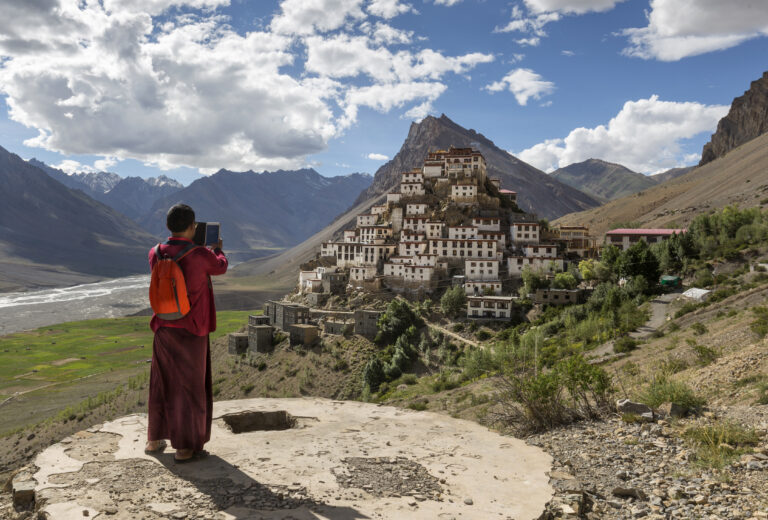
Spiti Valley rewards a photographer who notices the journey as well as the destination. This route begins among Shimla’s wooded hills, turns into the Baspa Valley for Chitkul, continues through Nako towards Kaza, and reaches Kunzum and Chandratal when access allows. The visual thread is the change in landscape: trees and river settlements give way to exposed slopes, monasteries and high-country light. The aim is a coherent photographic story rather than a collection of famous viewpoints.
The Shimla–Chitkul stretch introduces the contrast that runs through this journey. Look for the transition from buildings against wooded slopes to the relationship between a village, its fields and the Baspa River. Chitkul is a detour into the Baspa Valley, not a pass on the main road to Kaza. Consult Himachal Tourism’s Kinnaur guide when mapping this part of the trip. Allow time to return to your onward route rather than treating every place name as a single straight road.
Nako: Where Tranquility Meets Tradition
Nako belongs to Kinnaur and forms a distinct chapter on the approach to Spiti Valley. Its lake, monastery and settlement offer subjects on a more intimate scale than the broad road landscapes. A useful photographic sequence might move from a view of the village to an architectural detail, then to the lake in its surroundings. Avoid treating prayer flags or religious objects simply as foreground props. The official monastery guide provides context for Nako’s religious heritage.
Kaza Town: Gateway to Spiti Valley Heart
Kaza is a practical base for exploring Spiti Valley, but the town deserves attention beyond its role as a stop for supplies. Roads, shops and everyday activity can help connect the larger landscapes to the people who live here. Plan Dhankar as a separate excursion between Tabo and Kaza. Build a plan around realistic travel and rest rather than making every named destination a same-day obligation.
Dhankar Monastery: Where History Meets the Horizon
Dhankar’s cliffside setting gives the photographer two related subjects: the building and the land that supports it. Start with a view that explains that relationship before looking for architectural details. A longer focal length can isolate forms without requiring you to approach an unsafe edge. Follow the access arrangements on the day, keep to permitted paths and ask before photographing inside. The visual drama is already present; it does not need a risky position or an invented story about the monastery.
Key Monastery: A Beacon of Buddhist Heritage
At Key Monastery, also written Kee or Ki, the arrangement of buildings against the slopes offers a different composition from Dhankar. Make a frame that shows the setting, then consider a closer view of the structure. Interiors and ceremonies require permission, and an open doorway is not an invitation to photograph everything beyond it. Keep camera sounds and conversation unobtrusive. Allow the place to remain a working religious setting while you look for a photograph.
Langza, Komic and Hikkim: Village Life in the Landscape
Langza, Komic and Hikkim bring the journey into a group of high villages where fields, homes and roads can matter as much as a landmark. Hikkim’s post office offers one point of interest; the surrounding settlement gives it context. Instead of seeking a record-breaking location, look at how the buildings sit within the larger landscape. Approach each village as a place with contemporary life, and leave time for more than a quick landmark photograph.
Kunzum Pass: A Portal to Ethereal Beauty
Kunzum belongs to the seasonal crossing towards the Chandratal part of this journey. The official Spiti Valley guide is useful background, but a general visiting season cannot confirm today’s pass conditions. Check access close to departure and be ready to omit this leg. If you stop to photograph, agree a safe place with your driver and stay clear of moving traffic. A mountain pass is not a location where a composition should take priority over conditions.
Chandratal Lake: A Magnum Opus of Light and Landscape
Chandratal, also written Chandertal, brings water and reflected light into the sequence after the road and village photographs. The Ramsar record for Chandertal Wetland places it in the upper Chandra valley near Kunzum and identifies its conservation importance. Reflections depend on the wind; sunrise and sunset do not guarantee a mirror surface. If conditions are unsettled, work with the shoreline and mountain forms rather than waiting for the lake to reproduce an expected picture.
Capturing the Essence of Spiti:
The beauty of Spiti Valley becomes more legible when the photographs work together. Select a wide view that establishes the landscape, a middle-distance frame that shows human scale, and a detail that gives the sequence texture. These are possible roles rather than a compulsory formula for every stop. Review what each image contributes before making another variation of the same view. A strong sequence often comes from choosing carefully, not returning with the largest file count.
Give each part of the journey a different visual purpose. In Shimla and Chitkul, look for the relationship between buildings, trees and water. Around Nako, consider quieter frames with fewer competing elements. At Dhankar and Key, the arrangement of architecture against the slopes can carry the picture. At Chandratal, decide whether the water is your subject or a way to describe the mountains. That small decision helps a Spiti Valley photo essay develop rather than repeat itself.
Preservation Through Photography:
Conservation belongs in the decisions made while taking a photograph. The Ramsar record identifies litter and visitor pressure among the concerns around Chandertal. Stay on established access, carry your waste back and follow local directions on where visitors may stop or stay. Do not move stones, enter fields or approach wildlife simply to improve the frame. Photographs can document the landscape, but taking a photograph does not itself preserve it.
Planning a Photographic Journey Through Spiti Valley
A workable Spiti Valley itinerary gives the important locations room to breathe. Mark which stops are essential to your photographic idea, which are optional, and where you can shorten the route if conditions change. Allow for rest as well as driving. Avoid putting a crucial onward connection immediately after the most uncertain leg. This is a route narrative, not a promise that all of its places fit into a fixed number of days.
For each overnight stop, choose one photographic priority rather than trying to reserve every sunrise and sunset for a different destination. If Key is your priority, discuss the timing and return journey with your driver before adding another distant stop. If Chandratal is central to the trip, keep a substitute subject ready in case access is unsuitable. A clear priority gives you a reason to stay with an interesting scene instead of leaving because the next place is on a list.
A practical planning note needs only a few entries: your overnight base, the main subject, transport arrangements, the latest information to check and an alternative. Confirm whether meals and the accommodation services you need are available on your dates. Ask which part of a day’s journey is most uncertain. This makes the route easier to revise without pretending that a suggested timetable can account for every road delay or change in conditions.
Camera Technique: Responding to Light and Movement
Choose camera settings in response to the scene. A tripod can help with a static low-light landscape where its use is permitted; a faster shutter is more useful for moving flags, people or a handheld photograph from a safe stopping place. Check the histogram and important highlights rather than trusting the screen in bright light. For a panorama, take a deliberate overlapping sequence and keep exposure consistent. None of these techniques requires a particular camera brand or an expensive new kit.
Choosing the frame before changing the settings
Start by deciding what belongs in the photograph. A wide-angle view can connect a foreground to distant mountains, but extra foreground is useful only when it contributes. A tighter frame can simplify overlapping slopes or show how a monastery fits its setting. Look around the edges for distractions before pressing the shutter. In Spiti Valley, where the scale can dominate attention, a carefully chosen boundary often does more for the image than another adjustment to the camera.
Working with bright skies, moving water and wind
When a bright sky and shaded land compete, check which details matter to the picture. Try a different framing or wait for a change in light before assuming a complex processing solution is necessary. If you make several exposures for a later blend, inspect the frames for movement that could complicate it. At the lake, compare a reflection-led composition with one built around ripples or the shoreline. Wind can change the subject rather than simply spoil it.
Review one frame closely before making a long series. Check focus on the subject you intended to emphasise, inspect for unintended movement and look for clipped highlights. Use a small test sequence when trying an unfamiliar technique. Record enough information to understand the result later, then return your attention to the place. The objective is a dependable photograph of the scene in front of you, not a demonstration of every camera function.
Cultural Encounters Through the Lens
Cultural photographs need the same care as landscape photographs, with the added responsibility of consent. Ask before making a close portrait, accept refusal without argument, and avoid interrupting work or worship. A conversation may offer more understanding than an immediate photograph. When writing captions, separate what you know from what the image suggests: a person’s clothing or expression cannot establish their beliefs, circumstances or feelings.
Photographing Villages Without Stereotypes
The village sequence can show continuity and change without making claims about a disappearing way of life. Look for the relationship between houses, cultivated land, paths and contemporary activity. Ask before entering private spaces, and avoid directing residents to perform a scene for the camera. A useful caption might identify a confirmed place and subject; it need not turn an ordinary moment into a story about isolation or timelessness.
In the final selection, give people more than a decorative role beside scenery. Include a portrait only when you have permission and a reason for it in the story. If no suitable interaction develops, an architectural or landscape sequence can stand on its own. Captions should help the reader understand Spiti Valley without assigning thoughts to strangers. Keep a note of confirmed place names while travelling so that later editing does not depend entirely on memory.
Challenges and Triumphs: The Photographer’s Journey
Cold, dust, changing light and long travel days affect both equipment and attention. Carry a spare charged battery and protect the camera between stops. Change lenses in shelter when possible, and check for dust before an important series. Make a second copy of photographs when practical and keep it separate from the first. If you feel unwell, stop and seek appropriate help; completing a planned shot is never a reason to continue regardless of your condition.
Roads, Access and a Seasonal Alternative
Before travel, confirm roads, accommodation and any route-specific entry requirements for your nationality with the relevant authorities or a qualified local operator. Ask what happens if a pass closes or you need an extra rest day. For a seasonal contrast, PicknStory’s winter Spiti article explores a different version of the region; its conditions should not be assumed to match this broader circuit. Avoid treating a published itinerary as a live access bulletin.
Frequently asked questions
Which route does this photographic journey follow?
The narrative starts at Shimla, takes a detour to Chitkul, continues through Nako towards Kaza, then considers the villages, monasteries, Kunzum and Chandratal. These are separate legs and excursions. Map the road connections and confirm access rather than reading the place names as a single uninterrupted highway.
Is a summer visit enough to guarantee access to Chandratal?
No. The season is only a starting point for planning. Confirm the approach road, local restrictions and available services close to departure. Keep an alternative in the itinerary so that a closed or unsuitable route does not turn into pressure to continue.
Do I need a professional camera for Spiti Valley photography?
No particular camera category is essential to tell a thoughtful visual story. Use the camera you can handle confidently, protect it from the conditions and make deliberate compositions. Familiarity, safe positioning and attention to light matter more than adding unfamiliar equipment immediately before the trip.
Can I photograph inside monasteries or take portraits in villages?
Ask permission and follow the rules for the specific space or occasion. Public access does not automatically include photography permission. Accept a refusal, avoid disrupting worship and ask before close portraits or entry into private areas.
How can I protect my photographs during the trip?
Protect the camera from dust between stops and carry a spare charged battery. When practical, make a second copy of your files and keep it separate from the first. Check that a backup has completed before treating it as reliable, and avoid deleting the only copy of an image while travelling.
Planning sources and review date
Background checked on 28 October 2026 against the official sources linked in this article. Road conditions, permissions and services must be checked again for your actual dates.
Conclusion: A Story Through the Lens
A photographic journey through Spiti Valley works best when the final selection explains what drew you along the route. The change from wooded hills to villages, monasteries, exposed mountains and water provides a natural structure. Keep the frames that contribute to it, caption only what you can substantiate, and leave room for the landscape to look different from your expectations. The result should share attentive observation rather than promise an untouched world.