Gig economy India 2026 is the phrase that sounds modern, flexible, and a little bit rebellious. It is also the phrase that hides some very old Indian realities: long hours, thin margins, and workers carrying the entire risk on their own backs. I have ordered late-night food in Delhi when it rained, when guests were coming, and when I was too tired to cook. Like many urban consumers, I love the convenience. But as I kept seeing delivery partners outside my gate in heat, fog, and traffic chaos, I started asking a harder question: what does that convenience actually cost the person riding the bike?
That question became impossible to ignore in 2026. Gig economy India 2026 is no longer just about app-based delivery or cabs. It is about a new kind of urban labor where the worker is visible on the street but invisible in the system. My own Delhi life has taught me this in small moments. A driver once told me he had been online for eleven hours and still had not crossed a decent earning threshold. Another delivery partner in my lane said the bonus looked attractive on screen, but by the time he paid for petrol, phone data, and repairs, the day felt almost wasted.
This article is my honest reckoning as a consumer who also lives in the city that runs on these workers. I am not writing as an activist or a policymaker. I am writing as someone who has benefited from the gig economy and still wants to understand it honestly. If you care about the future of work, the human cost of convenience, or the rise of AI-run platforms, you may also want to read our story on AI in everyday life later. For now, let us look at gig economy India 2026 without the glossy app screens and without the marketing language.
The Gig Economy Promise vs the Ground Reality in 2026
Gig economy India 2026 is sold as freedom, entrepreneurship, and quick income. The pitch is seductive. You choose your hours, you become your own boss, and money starts flowing as soon as you log in. However, the ground reality in Delhi is much messier. Most workers do not enjoy full freedom. They chase incentives, accept low-value orders, and stay online during peak demand because the algorithm rewards availability more than dignity. Gig economy India 2026 looks flexible from the customer side, but for the worker it often means being permanently on call.
Gig economy India 2026 and the promise of flexible work
Gig economy India 2026 appeals to people who need fast cash and cannot wait for formal hiring cycles. That includes students, migrants, unemployed graduates, and workers who lost steady jobs. The promise is simple: earn when you need, rest when you want. But in practice, resting means losing ranking, losing incentives, and sometimes losing access to better orders. The worker is technically free, yet every app nudges them to keep moving. In Delhi, that means riding through pollution, traffic, monsoon water, and winter fog just to stay visible to the system.
Why the promise often breaks in Delhi traffic
Gig economy India 2026 breaks down fastest in a city like Delhi because distance is deceptive. A 4 km order can become a 25-minute ride because of signals, gates, parking, and blocked roads. A cab driver can lose thirty minutes simply trying to reach a pickup point in a crowded market. I have watched riders wait outside office towers in Gurugram and then race to Noida for the next ping, burning fuel the entire time. The app shows earnings. It rarely shows the unpaid waiting, the fatigue, or the stress of trying to beat traffic while the clock keeps punishing you.
What a Delivery Partner Actually Takes Home Per Month in Delhi
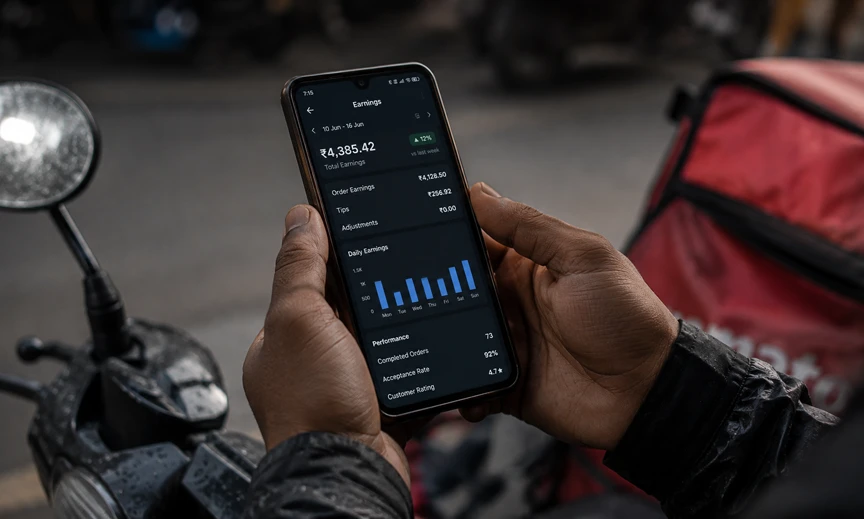
Gig economy India 2026 becomes real only when you do the monthly math. Let us take a practical Delhi model for a food delivery worker, based on six days a week, about ten to eleven hours a day, and roughly 26 working days a month. Suppose the gross order-based earnings and incentives total around Rs 32,000. That may sound respectable. However, platform commissions, delivery fees adjusted by the app, and performance-related cuts can leave the worker with less than that on paper. Then the hidden expenses begin. Gig economy India 2026 looks very different once these deductions are counted honestly.
Gig economy India 2026 income model for a delivery worker
Start with Rs 32,000 gross. Subtract petrol or charging costs of around Rs 4,500 to Rs 6,500 depending on the vehicle. Add phone data and recharge at roughly Rs 500 to Rs 800. Vehicle maintenance, punctures, servicing, chain replacement, oil changes, and occasional brake work can easily touch Rs 2,500 to Rs 4,000 a month averaged across the year. If the worker rents a bike or pays installment on a scooter, the number worsens. A realistic net take-home in many months can fall to around Rs 20,000 to Rs 24,000, and that is before any health emergency or lost working day.
What cab platform workers keep after fuel and wear and tear
Gig economy India 2026 is not kinder to cab drivers. A driver may show Rs 45,000 to Rs 60,000 in monthly trip earnings, but the real picture changes after aggregator deductions, surge uncertainty, fuel, fast tag, maintenance, EMI, cleaning, and insurance. A driver with a financed vehicle can easily lose Rs 15,000 to Rs 22,000 each month to fixed and variable costs. In Delhi, where traffic kills fuel efficiency, the take-home often shrinks fast. What looks like a healthy turnover is sometimes just a busy way of breaking even.
The Platform Algorithm: The Invisible Boss No Labor Law Covers
Gig economy India 2026 is ruled by software that behaves like a boss without ever looking like one. The algorithm decides who gets what order, who gets priority, who gets punished, and who disappears from the map of opportunities. That invisible control is one reason workers feel exhausted even when they are technically independent. They are not managed by a human supervisor in an office cabin. They are managed by ratings, response times, acceptance rates, and data patterns that can change without warning. Gig economy India 2026 creates a strange kind of workplace where the app is always watching.
Gig economy India 2026 and the pressure of ratings
In Delhi, a low rating can hit a worker harder than a bad day of weather. One angry customer, one delayed parcel, or one traffic jam that is beyond the worker’s control can affect future order flow. The app does not always explain why a worker is deactivated, shadow-banned, or shown fewer incentives. The silence is the punishment. This is why so many riders keep apologizing even when they are not at fault. Gig economy India 2026 has turned customer satisfaction into a survival metric, and that is a dangerous imbalance.
No PF No ESI No Floor: The Missing Safety Net for Gig Workers
Gig economy India 2026 still leaves millions outside the basic safety net that formal workers take for granted. No provident fund. No proper employee state insurance in the full sense. No guaranteed minimum wage floor. No paid sick leave. When a delivery partner falls from a bike, gets dengue, or is injured in traffic, the loss is immediate and personal. The app pauses. The bills do not. Gig economy India 2026 promises inclusion, but for many workers the real experience is inclusion in demand and exclusion in protection.
Why injury can turn into debt
A minor crash can become a financial disaster. If the bike is damaged, the worker pays repair costs. If the worker is hurt, there is no guaranteed income replacement. If medical treatment is needed, cash flow stops at the exact moment expenses rise. This is why workers often ride through pain, illness, and exhaustion. The fear of missing the day’s earnings is stronger than the fear of worsening the injury. Gig economy India 2026 is therefore not just an income story. It is a risk-transfer story, where the company offloads uncertainty onto the least powerful person in the chain.
The Hidden Costs Nobody Counts When Calculating Gig Income
Gig economy India 2026 is usually discussed in terms of gross monthly income, but that number hides the real cost structure. Petrol is obvious. Maintenance is obvious. What stays hidden is everything else: waiting time, dead kilometers, phone battery wear, data usage, rain gear, winter jackets, gloves, water, roadside food, and the mental cost of always being available. In Delhi, every extra kilometer is not just distance. It is dust, stress, and fuel. Gig economy India 2026 becomes a lot less glamorous when you account for these small but relentless leaks.
Gig economy India 2026 and the everyday expense sheet
Workers also lose money in ways customers never see. A cab driver may spend on deodorizer, seat covers, tolls, cleaning, and the occasional fine. A delivery worker may pay for mobile accessories, power banks, rain covers, and repairs after potholes or falls. Then there is depreciation. A bike used for 10 to 12 hours daily wears out much faster than one used casually. If you spread that cost honestly, the monthly take-home shrinks further. Gig economy India 2026 only looks profitable when you ignore the machine eating itself to keep the app running.
Gig Work and Mental Health: The Isolation Nobody Discusses
Gig economy India 2026 also creates a mental health cost that rarely appears in earnings screenshots. Workers spend long hours alone on roads or in traffic, often speaking more to the app than to another human being. They handle rude customers, uncertain income, safety fears, and social judgment. Many families still see gig work as temporary or inferior, which adds shame to strain. Gig economy India 2026 can feel like freedom on the surface, but inside it often feels lonely, fragmented, and emotionally tiring.
Gig economy India 2026 and stress on the body and mind
Financial stress is not just a wallet problem. It affects sleep, focus, anger levels, and physical health. The National Institutes of Health has explained how financial stress links to poor health, and that connection is painfully visible among delivery and cab workers. Long hours, uncertain income, and the pressure to stay online can make small problems feel huge. In Delhi, heat, smoke, and traffic add another layer. Gig economy India 2026 is often a story of bodies that are tired before the month is over.
Why isolation is a workplace issue
The loneliness is structural, not personal weakness. A gig worker cannot easily vent to a team, ask a supervisor for help, or build stable peer support during the day. The platform is efficient at allocating tasks, but not at offering care. Some workers develop a silent toughness, while others burn out and quit. The WHO notes that mental health is central to overall health, and gig economy India 2026 makes that truth impossible to ignore. If work leaves people isolated and anxious, the system needs redesign, not applause.
The Startup Success Story vs the Ground Truth for Platform Workers
Gig economy India 2026 is celebrated as an innovation story. Investors like scalable models. Founders like growth charts. Consumers like fast delivery. But the success story often skips the worker standing in the heat at the edge of that chart. In startup decks, the platform looks efficient and asset-light. On the ground, workers absorb fuel volatility, traffic risk, and income uncertainty. Gig economy India 2026 is therefore a tale of two India s: one in boardrooms, and one on the road.
Gig economy India 2026 and the language of scale
Scaling often sounds like a neutral word. In reality, it can mean doing more with less labor protection. When a platform expands, the worker base grows, but bargaining power does not necessarily grow with it. The company can enter new pin codes quickly. The worker cannot easily switch to a better system because the better system barely exists. That is the hidden contradiction. Gig economy India 2026 is praised for job creation, but the quality of those jobs is the real test.
Why consumers also buy the illusion
We consumers are part of the illusion because the platform language makes us feel modern and efficient. We see low delivery fees and quick rides, not the subsidy hidden in worker fatigue. I admit this includes me. When a cab arrives in five minutes, I feel relieved, not suspicious. But relief should not come from someone else’s economic squeeze. Gig economy India 2026 will only become a real success story when growth is matched by dignity, not just app downloads and investor optimism.
What Needs to Happen for India’s Gig Economy to Work for Everyone
Gig economy India 2026 needs honest reform, not just nicer branding. The first fix is transparent earnings math. Workers should see a clean breakdown of what the customer pays, what the platform keeps, and what the worker actually takes home. The second fix is a floor for earnings after costs, not just incentives that can vanish overnight. The third fix is portable social security, meaningful insurance, and a fast grievance process. Gig economy India 2026 can only work if the worker is treated like a person with rights, not a disposable node.
Gig economy India 2026 and practical policy changes
Policy should focus on enforceable minimum standards, safety coverage, and transparent algorithms. There should be clarity on deactivation, appeal rights, and working-hour protections. It also helps if platforms contribute fairly to a welfare fund based on actual transactions. Cities like Delhi need better rest points, toilets, drinking water, and safe parking for riders and drivers. Gig economy India 2026 is not just a national labor question. It is an urban infrastructure question too.
What consumers can do differently
We can ask better questions. We can stop treating extreme speed as the only definition of service. We can tip fairly when appropriate, avoid unnecessary complaints, and remember that behind every app icon is a person riding through our city. I think that shift matters. Gig economy India 2026 will not improve only through laws or startups. It will improve when citizens, companies, and policymakers accept that convenience has a human chain, and that chain deserves dignity.
Frequently Asked Questions
How much does a Swiggy or Zomato delivery partner earn per month in India in 2026?
Gig economy India 2026 earnings for a delivery partner vary by city, hours, and incentives. In Delhi, a realistic gross monthly figure may look like Rs 25,000 to Rs 35,000 for active workers. However, after petrol, phone costs, maintenance, and platform deductions, the net take-home can often fall closer to Rs 18,000 to Rs 25,000. Busy months can be better, but the pay is unstable and highly dependent on demand.
What percentage does the platform take from each delivery order in India?
Gig economy India 2026 does not have one fixed national percentage because each platform uses a mix of commissions, service fees, and incentive structures. The visible deduction may look small, but the real platform share can be much larger once order pricing, bonuses, surge rules, and customer charges are included. Workers often feel the system is opaque because the final earnings are not always easy to calculate order by order.
Are gig workers in India entitled to PF ESI or minimum wage protection under current law?
Gig economy India 2026 still leaves many platform workers outside traditional PF and ESI-style employee protections because most are classified differently from regular salaried staff. Some welfare measures now exist in principle, but full employee status is not automatic. Minimum wage protection also remains weak in practice for gig tasks. The legal position is improving in parts, but workers still face major gaps between formal recognition and actual benefits.
How many hours does an Indian delivery partner typically work per day to earn a living wage?
Gig economy India 2026 often requires long shifts. Many delivery partners work around 10 to 12 hours a day, sometimes six days a week or more, especially in metro cities like Delhi. To reach a livable monthly amount after expenses, workers usually need to stay online through peak lunch and dinner slots. The pressure to chase incentives can make the workday longer than it first appears on the app.
What are the hidden costs that reduce a gig worker’s actual take-home income in India?
Gig economy India 2026 hides many costs beyond fuel. Workers pay for phone data, charging, rain gear, helmets, bike servicing, tyre wear, oil changes, cleaning, and occasional fines or tolls. If they finance their vehicle, EMI becomes another burden. A day lost to illness or repair also means lost earnings. These hidden costs can shrink a seemingly decent gross income into a much smaller monthly take-home.
Can an Indian gig worker claim any benefits if they are injured while working?
Gig economy India 2026 does not guarantee the kind of injury protection a formal employee might expect. Some platforms may offer limited accident cover or insurance-linked support, but the details vary widely and claims can be slow. If a worker is injured, income often stops immediately while medical bills continue. That gap is why many workers keep riding even when they are unwell, which makes the risk worse.
Why are India’s gig workers going on strike and what are their core demands in 2026?
Gig economy India 2026 has seen repeated protests because workers want better pay, transparent algorithms, safe conditions, and real social security. The core demands usually include fairer commissions, protection from sudden deactivation, accident insurance, minimum earning guarantees, and clearer grievance redressal. Workers are not only asking for higher income. They are asking for dignity, stability, and a system that does not shift every risk onto them alone.
How does algorithmic management affect income and job security for Indian platform workers?
Gig economy India 2026 uses algorithmic management to assign orders, track acceptance, and shape earnings. This affects job security because workers can be deactivated or penalized with little explanation. It also affects income because the system rewards speed, availability, and favorable ratings. A single bad week can lower access to good orders. That is why workers often feel they answer to a machine instead of a manager.
What is the difference between gig work and contract employment in India legally?
Gig economy India 2026 sits in a grey zone between independent work and formal employment. In contract employment, a worker is usually tied to a contract with clearer duties, protections, and some labor rights. Gig work is more fragmented and platform-driven, with less predictable control and fewer guaranteed benefits. The legal distinction matters because it shapes access to PF, ESI, leave, and dispute resolution. For more context on earning models, see our guide to earning money using AI in India.
I want a future where a delivery partner can work hard without being crushed by uncertainty, where a cab driver can plan a month without feeling one breakdown away from panic, and where policy actually reaches the street. Gig economy India 2026 can improve, but only if we stop calling exploitation efficiency. If we get honest about the numbers and the human cost, we can still fix this. Gig economy India 2026 must become a system where convenience and dignity travel together. Until then, the promise remains incomplete, and the worker keeps carrying the gap.
Disclaimer Note: Income figures and deduction estimates in this article are based on publicly available reports, journalistic investigations, and aggregated worker accounts. Earnings vary significantly by city, platform, hours logged, and vehicle type. This article does not make claims on behalf of any specific platform company. Prabhjit will write and insert the final disclaimer text manually.
Conclusion
The story of gig economy India 2026 is ultimately a story about people. Behind every food delivery, cab ride, grocery order, or quick doorstep service is a worker trying to build a stable life in a system that often rewards availability more than security. The convenience many of us enjoy every day is powered by individuals who absorb the risks of fuel prices, vehicle repairs, health emergencies, and unpredictable earnings.
That does not mean the gig economy is inherently bad. For many Indians, it has created opportunities that did not exist a decade ago. It offers flexibility, quick entry into the workforce, and a source of income for millions. The challenge is that opportunity without protection can quickly become vulnerability. When workers carry all the uncertainty while platforms capture most of the stability, the model begins to feel unbalanced.
The future of gig economy India 2026 should not be a choice between innovation and worker welfare. Both can exist together. Fair pay, transparent systems, social security, and basic dignity are not obstacles to growth. They are what make growth sustainable.
Because in the end, a modern economy should not be judged only by how fast it delivers convenience, but by how fairly it treats the people delivering it.